What "Cinematic" Actually Specifies
If you are still deciding whether a listing needs video at all, that question is answered in what real estate videography does for a property, and the campaign around a launch is covered in marketing a Vancouver listing.
This guide assumes the shoot is booked. It covers the craft: what goes on the shot list, which movement suits which property, how long the cuts run, what the audio has to do, and how the colour holds from room to room.
Cinematic is not a mood. It is a set of decisions written down before anyone arrives. A walkthrough records a property; a cinematic film sequences it.
The Eight Shots That Build a Listing Film
The list changes with the property, but these eight cover most Vancouver homes and work in roughly this order. Cut what does not apply rather than shooting all eight out of habit.
1. Establishing Exterior
A wide, mostly static frame: street, elevation, setting. It runs first because every shot after it is read against it. If the exterior is the weakest part of the property, hold it briefly and move on.
2. The Arrival
The approach: up the path, along the driveway, through the lobby. A slow forward move at eye height, following the route a person would actually take.
This is the shot no photograph can do: it gives the buyer the sensation of arriving instead of teleporting to the kitchen.
3. The Entry Reveal
A move through the doorway onto the main space. The frame starts partly obstructed and clears.
Reveals are the strongest device in the whole sequence, which is why you use one. Three in ninety seconds reads as a gimmick.
4. The Hero Room Push-In
Every property has one room that sells it. Push slowly into it from its best entry point and let the frame settle.
Slow enough that the viewer reads the space rather than the motion. If the camera arrives before the eye does, the shot is too fast.
5. The Kitchen Orbit
A lateral move around an island, or a slow arc past a run of cabinetry. Parallax is the point: as the camera travels, foreground and background separate and the room reads as three-dimensional.
Kitchens reward the move more than any other room, with depth, hard edges, and reflective surfaces that change with the angle.
6. The View Pull-Back
For a view property, this is the shot the listing exists for. Start tight on the view, then pull back to reveal the room it belongs to.
It answers the question every view listing raises: what am I standing in when I look at this? Reverse it and you have a postcard.
7. Detail Inserts
Short, static or barely moving frames of what justifies the price: the tap fitting, the tile edge, the stair detail, the millwork.
Inserts are the cutaways that let an edit change rooms without a jarring jump. Capture more than you think you need. They rescue a sequence that otherwise will not cut together.
8. The Twilight Closer
The last image the buyer holds: exterior at dusk with the interior lights on, or a slow pull away from the lit house. It closes well because it is the only frame that shows the property as a place someone lives rather than a place being viewed.
Watch the Grammar in a Finished Film
Watch this once for the property, then again for the structure.
Track these as it plays:
- Which frame establishes the property, and how long it holds before the first cut
- Whether the camera arrives at the entry or starts inside it
- Where the single reveal sits, and what it withholds first
- How slowly the hero room push-in travels
- Whether the movement in each shot has one direction or several
- Where the detail inserts fall, and which room changes they cover
That checklist is the shot list read backwards. Name what each shot does and you can brief it on the next property.
Movement Vocabulary, and What Justifies Each
- Locked-off (static): no movement. Still the right answer for detail inserts, small rooms, and anywhere motion would only reveal how tight the space is.
- Slider: a short, controlled move on a rail. Precise, repeatable, the most useful move in an interior: parallax without the floated feeling of a stabilised walk.
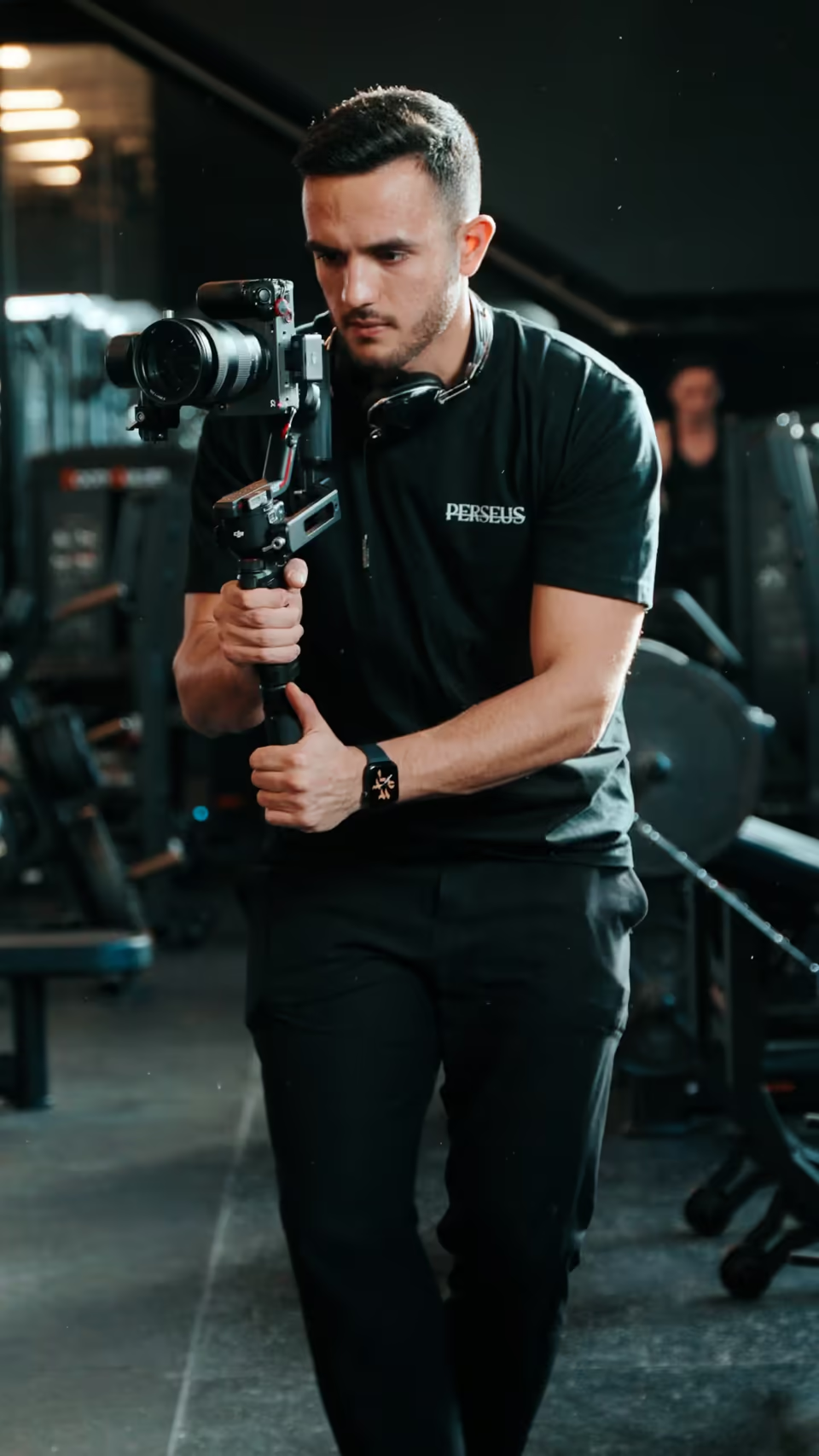
- Gimbal glide: a stabilised walking move. Covers distance, connects rooms, carries arrivals and reveals. Overused because it is easy: a whole film of glides feels weightless and no room registers.
- Handheld: deliberate, subtle instability. Rare here, but it suits character homes where perfect smoothness reads as sterile.
- Jib or crane: a rising or falling move. Strong for double-height entries, stairwells, and elevations where height is the feature.
- FPV: a fast continuous flight through a space. High impact, high risk: it shows off the operator, not the property, and makes a small home look chaotic. It earns its place on large open-plan properties and developments selling scale.
- Aerial: its own discipline with its own planning, covered in drone videography for Vancouver listings.
Match the movement to the property, not to the equipment in the car. A downtown condo is mostly sliders and locked-off frames, because a gliding camera in a small room only proves it is small. A detached family home wants gimbal for the connecting moves and sliders for the rooms that matter. A luxury or architectural property justifies the jib, the longer reveals, and the slowest pushes. A townhome is a stairs problem. Plan the vertical transitions first, because they decide whether it feels like one home or three floors filmed separately.
One rule holds throughout: one motivated move per shot. A pan that becomes a tilt that becomes a push is three ideas fighting inside one take, and the viewer reads none of them.
Pacing: A 60 to 90 Second Film Is Not a Shorter Tour
Length is a structural decision, not a trim.
A horizontal film in the 60 to 90 second range holds roughly the eight shots above plus a handful of inserts. Most cuts land between two and four seconds. The exceptions are deliberate: the establishing frame and the hero push-in hold longer, because they ask the viewer to read something.
Cut on the music. A cut that lands off the beat feels wrong even to a viewer who could not say why, which is why the track is chosen before the edit is assembled rather than laid under a finished sequence.
Front-load it. The strongest frame belongs in the first few seconds, because that is where the audience decides whether to keep watching.
The vertical cut is a different film, not a crop:
- Re-edit from the source. A 16:9 composition cropped to 9:16 loses the composition that made it work.
- Plan vertical framing on the day: shoot the hero moves again held vertically, or compose centre-safe.
- Vertical runs shorter, and the cuts with it. Around twenty seconds carries roughly six to eight shots.
- Open on the most striking frame, not the establishing exterior. Vertical audiences arrive mid-scroll.
- Keep the top and bottom of frame clear, because platform interface elements sit there.
- Assume it plays silently first. Anything the film has to say must survive with the sound off.
Sound Design and the Licensing Reality
Music sets the pace, and it should be chosen before the edit so the cuts have something to land on. Under it, a thin layer of ambience (room tone, distant city, water) gives the space physical presence. A few effects used sparingly, a door, footsteps on hardwood, a fireplace, do more than another music swell.
Most listing films need no voiceover. The moment the agent speaks, the format becomes brand content. Mix for a phone speaker, because that is where the views happen.
Licensing is where listings get into trouble:
- A track from a personal music streaming subscription carries no sync rights. Listening rights are not usage rights.
- Licensed production-music libraries sell per-track or subscription licences. Read what the licence covers.
- A licence covering organic social posting often does not cover paid advertising. Confirm before the listing is boosted.
- Subscription licences can lapse with the subscription. Register the track to the project while it is active.
- Platforms scan uploads for copyrighted audio and can mute or restrict a video without warning.
- Keep the licence record with the project file. Whoever needs it later is rarely whoever chose the track.
Colour and White Balance Across Rooms
A film moves between lighting conditions a photograph gets to handle one frame at a time. That is the whole difficulty.
Set white balance manually and lock it for the length of a move. Auto white balance shifts mid-shot when the camera pans from a bright window to a lamp-lit wall, and the shift is visible in the delivered file.
Shoot a grey or white reference at each lighting setup: seconds on the day, an hour saved in the grade.
Commit to one colour temperature per room and light towards it rather than fighting mixed sources in the grade. Pot lights and lamps read warm against daylight windows: turn them off, gel them, or accept the warmth and match every other room to it. A film where the kitchen is orange and the living room is blue looks like two properties.
Decide the window policy early. A view property has to hold the view, which constrains interior exposure; a property with no view can let windows go bright and keep the rooms clean.
Grade the sequence, not the shot. Two angles of one room have to read as one room. Then match the film to the stills gallery: buyers see both within a minute of each other, and a cooler, more contrasted film beside warmer photographs reads as two separate shoots.
When Twilight Earns a Second Call-Out
Twilight is not night. The usable window is the short period after sunset when the sky still carries colour and the interior lights read against it. It closes quickly, which makes it a second visit rather than the end of the main shoot.
It earns that visit when:
- The property has architectural or landscape lighting that only exists after dark
- A pool, deck, or outdoor living area changes when lit
- The elevation is strong and the campaign needs one hero frame to hang on
- A view reads better with city or water lights in it
It does not when there is no exterior lighting to switch on, when the building's lighting is not the seller's to control, or when the value is interior finish rather than presence.
Preparation decides whether the window is usable: interior lights on, blinds up, landscape lighting on, cars moved, bins out of frame. None of it can be fixed once the sky starts going.
One or two twilight frames and a closing move is usually all the film needs.
Watch the Same Grammar on a Different Property
Compare it against the first film: which of the eight shots the property justified, where the movement changes, whether the pacing is slower or faster, and how the colour holds between interior and exterior.
If two films share a grammar and still feel like different properties, the shot list is working. If they feel interchangeable, the treatment was applied instead of chosen.
Treatment Level by Property Type
The decision is not whether to shoot video. It is which treatment level the property justifies.
| Property type | Treatment level | What the shoot should produce |
|---|---|---|
| Studio or one-bedroom, no view | Stills-led | Photo gallery, floor plan, short vertical cut from static and slider frames |
| View condo | Motion-light | Photo gallery, short film built around the view pull-back, vertical cut |
| Townhome | Motion-light | Photo gallery, film with planned transitions between floors, vertical cut |
| Detached family home | Full film | Photo gallery, full eight-shot film, detail inserts, vertical cut |
| Character or renovated home | Full film | Photo gallery, full film with handheld texture, heavy insert coverage |
| Luxury detached or waterfront | Feature | Photo gallery, jib moves and long reveals, twilight closer, aerial, vertical set |
| Development or pre-sale | Feature | Renders and 3D as the primary asset, film for amenity and location context |
Read it as a floor, not a ceiling: one exceptional feature can justify a level up for that feature alone, and square footage by itself earns nothing. For which media types belong in a package at all, see choosing the right media mix.
When Cinematic Is Not Worth It
Some properties are made worse by a moving camera.
- A standard studio or one-bedroom with no view. Nothing to sequence, and the film advertises how small the rooms are.
- A unit identical to twenty others in the building. A film cannot differentiate what the floor plan does not.
- A tenanted property that cannot be cleared or staged. A still frame can be composed around clutter; a travelling camera cannot.
- A home that needs paint, repair, or decluttering. Fix the property first. A slow push-in through a tired room examines it.
- A pre-sale with nothing built. There is no subject. Renders, 3D, and floor plans carry that listing.
- A land-value property selling for the lot. The buyer is reading dimensions and orientation, so a top-down aerial and a survey do more.
- A listing where the media budget is tight. A strong photo gallery, a floor plan, and one vertical cut reach more buyers than a film that consumed everything.
The failure mode is not skipping the film. It is a cinematic treatment on a property with nothing to reveal.
How Perseus Creative Studio Helps Vancouver Realtors With Cinematic Listing Video
Perseus Creative Studio plans listing films the way this guide reads: shot list first, then movement, pacing, sound, and grade. Before a shoot we agree what the property has to reveal, which of the eight shots it justifies, whether the movement should be static, slider-led, or travelling, and whether twilight is worth a second visit. A downtown condo, a North Vancouver view property, and an East Vancouver character home each get a different shot list and a different pace, cut for both horizontal and vertical placement and graded against the photography.
Explore our real estate videography, photography, and aerial production services, or contact Perseus Creative Studio to plan the shot list for your next Vancouver listing.
Key Takeaway
Cinematic is a specification, not a style.
It means a named shot list, movement chosen for the property rather than the equipment, cuts timed to a track licensed for where the film will run, a locked white balance, and a grade matched to the photo gallery. Where a property has nothing to reveal, the honest answer is a stills package and a short vertical cut.
Brief the craft and the film looks composed. Brief the mood and it looks like every other listing video.