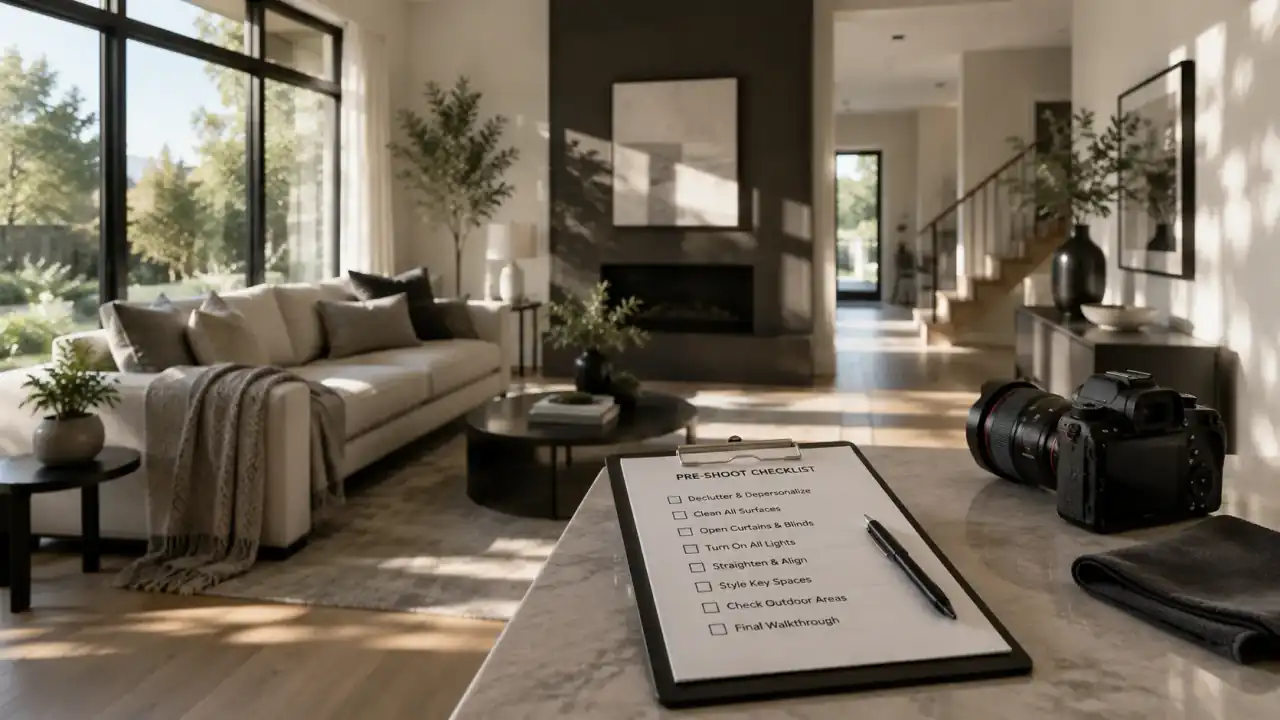
The Camera Is Less Forgiving Than a Showing
Your photographer is booked. In the next few days someone will walk through your home with a camera, and the images they take are what most buyers will see of your property long before anyone stands in it.
This guide is written for you, the homeowner. It goes room by room and tells you what to move, clean, replace, and put away before shoot day.
If you are the agent rather than the seller, the craft side of the shoot (gear, angles, lighting, editing) is covered in our guide to taking professional real estate photos.
A camera is less forgiving than a showing. At a showing a buyer walks through, talks to someone, and keeps moving. In a photo they stop on one frame and study it.
The soap bottle beside the sink, the charging cable on the nightstand, the recycling bin in the corner of the kitchen: none of it registers in person, and all of it registers online.
You do not need your home to look like nobody lives in it. You need it to be easy to understand.
Quick Answer
To get your home ready for listing photos: clear every flat surface, clean thoroughly, replace burned-out bulbs and match bulb colours within each room, wash the windows and mirrors, make the beds, empty the kitchen and bathroom counters, tidy the balcony or yard, pack away personal documents and photos, and move cars off the driveway. On shoot day, open the blinds, turn on every working light, secure your pets, and plan to be out of the house while the photographer works.
Everything below is the detail behind that list.
Start Days Ahead, Not the Morning Of
Most of this work is not cleaning. It is deciding what leaves the room.
The morning of the shoot is for final touches. Anything involving boxes, a trip to storage, a hardware store run, or the garden belongs earlier in the week.
A workable order:
- Move out furniture that crowds a room, which may need a truck or a storage locker
- Pack away personal items, paperwork, and anything you would not want photographed
- Replace burned-out and mismatched bulbs
- Deep-clean floors, windows, glass, and grout
- Tidy the yard, balcony, or patio
- Do the final surface sweep on shoot day
Packing boxes need to leave the frame, even if they cannot leave the house yet. A stack of them in the spare room or the garage reads as a rushed listing.
Living Areas
The main living space usually carries the gallery. It is where buyers judge the scale of the home, so it has to read as open and walkable.
Before the shoot:
- Straighten sofas, chairs, and cushions
- Clear the coffee table down to one or two objects
- Fold or remove excess blankets
- Hide remotes, chargers, and visible cables
- Put away toys, magazines, and laundry
- Align rugs with the furniture
- Keep the path to windows, fireplaces, and feature walls clear
- Wipe the television screen and any glass tabletops
If the room is crowded, take a piece of furniture out. This is the hardest instruction to accept. A camera flattens the depth your eyes use to separate objects, so a full room photographs smaller than it feels.
Entry, Hallways, and Stairs
These are transition spaces, and they are usually the first thing cleared and the last thing checked.
- Clear the shoes down to one pair per person, or none
- Thin out the coat hooks and the closet by the door
- Empty the entry table of keys, mail, and change
- Take everything off the stairs
- Clear the hallway floor end to end
- Remove door mats that are worn or muddy
Hallways connect rooms in the photo sequence, and they are what a video camera walks through.
The Kitchen
The kitchen influences how buyers read the condition of the whole home. It should feel clean, open, and functional, not sterile.
- Clear the counters down to one or two items
- Empty the sink and dry it
- Hide dish soap, sponges, and the paper towel roll
- Take everything off the fridge: magnets, notes, photos, school art
- Put away the toaster, kettle, blender, and other small appliances where you can
- Wipe appliance fronts, especially stainless steel, which shows fingerprints
- Clean the cabinet fronts and the backsplash
- Straighten stools and dining chairs
- Move garbage and recycling bins out of sight
- Empty and put away the drying rack
A bowl of fruit, a small plant, or a folded tea towel is enough styling. More objects will weaken the image, not improve it.
If your kitchen has stone counters, custom cabinetry, or premium appliances, make sure they are visible and not blocked by anything sitting on the counter.
Bedrooms
Bedrooms should feel calm and proportional. Buyers are reading whether their own bed and dresser would fit.
- Make the bed tightly, with the bedding pulled square
- Use clean, neutral bedding if you have it
- Clear each nightstand to a lamp and at most one object
- Unplug and hide charging cables
- Remove laundry, hampers, and anything visible under the bed
- Straighten curtains and blinds so they hang evenly
- Close closet doors unless the closet is being photographed
- Box up personal photographs if privacy matters to you
In a child's room, put the toys into one closed bin rather than trying to remove every trace of a child. Buyers understand that families live in homes. They just should not be counting the toys instead of looking at the room.
Bathrooms
Bathrooms are small, so two or three items read as clutter.
- Clear the counter completely, or down to a single item
- Put away toothbrushes, razors, and personal products
- Remove all medication
- Hide the garbage bin and the toilet brush
- Close the toilet lids
- Take shampoo and soap bottles out of the shower and tub
- Hang a clean, matching set of towels
- Remove bath mats if they look worn
- Clean the mirror and the shower glass
- Dry every surface, since water spots show clearly
- Check that the bulbs work and match
Reflective surfaces need a second look. A mirror shows whatever is behind the camera, which means the hallway or the room opposite the bathroom door has to be tidy too.
Home Office, Den, and Flex Rooms
Flexible space is valuable in Vancouver homes and condos, where square footage is under pressure. A room that reads as storage is a room the buyer does not count.
Give the space one obvious purpose before the shoot:
- Clear the desk
- Bundle and hide the cables
- File paperwork out of sight
- Tidy the shelves and leave gaps between objects
- Remove anything you are only storing there temporarily
- Add a chair, a lamp, or a plant if the room reads as empty
- Improve the lighting if the room is dim
A small den photographed as a work-from-home space, a reading corner, or a nursery becomes a selling feature. The same room photographed with bins in it becomes a closet.
Balcony, Patio, Yard, and Curb Appeal
Outdoor space carries real weight in Vancouver listings, and it is the area most often left until the morning of the shoot.
- Sweep the deck, patio, or balcony
- Put away hoses, tools, and cleaning supplies
- Remove broken or mismatched furniture
- Straighten the seating and wipe the table
- Clean railings and glass panels
- Move garbage and recycling bins out of the frame
- Tidy planters, pull weeds, and cut the grass
- Clean the barbecue or cover it
- Wash the exterior windows and the front door
- Sweep the walkway, porch, and driveway
- Move cars off the driveway, and off the street in front if you can
In the wet months, clear leaves off the deck and walkway on shoot day rather than the day before. They collect quickly.
The front of the house is often the first image a buyer sees, which makes it worth more attention than its share of the square footage suggests. Our guide to first impressions in listing photography explains what that lead image is doing.
Lights, Bulbs, and Windows
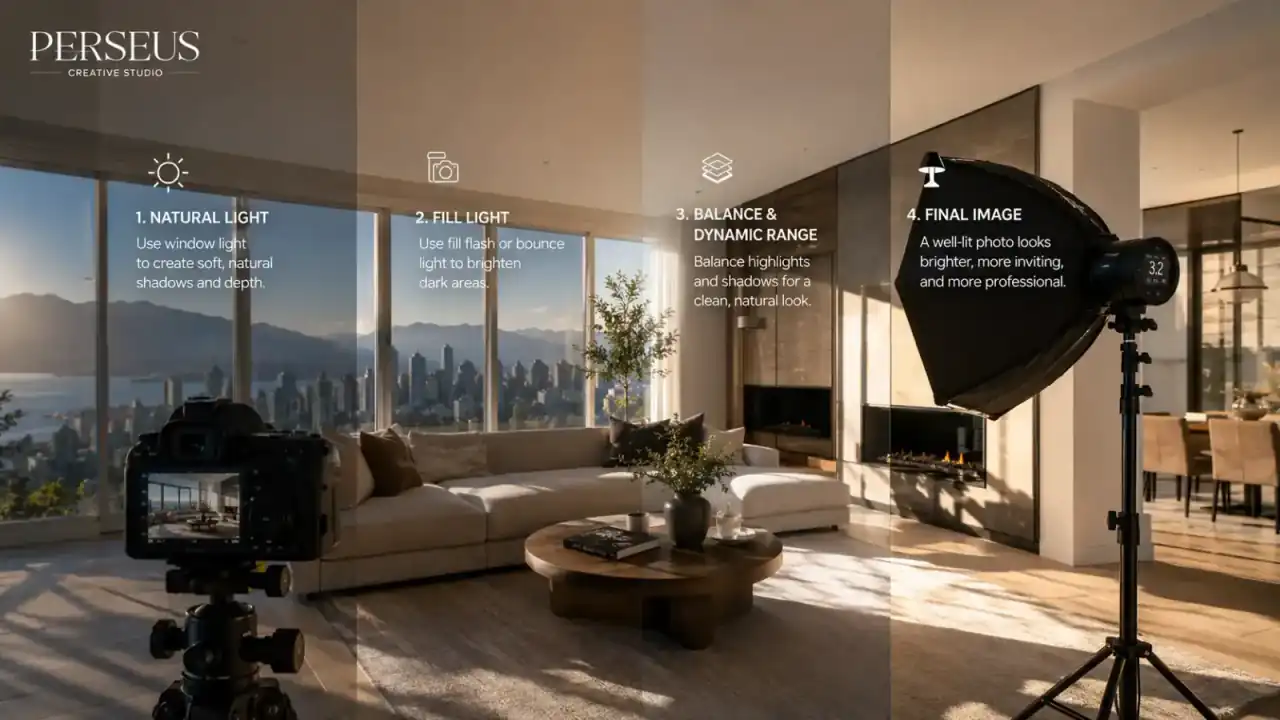
Lighting is the preparation job most easily skipped, and the one a photographer cannot fully repair afterwards.
Walk the house with a notepad:
- Replace every burned-out bulb
- Match bulb colour within each room, so half a room is not warm and the other half cold
- Check that every lamp works and is plugged in
- Clean the windows inside and out
- Open blinds and curtains, and confirm they operate smoothly
- Deal with dark corners, with a lamp if nothing else
- Test exterior lights if twilight images are planned
If your home has a view, the windows are the view. Dirty glass, heavy coverings, or a screen left in place can cost you the feature the listing is being sold on.
What to Put Away in Every Room
Some things weaken a listing photo wherever they appear. Doing one pass through the house for these is faster than catching them room by room.
- Personal documents and mail
- Medication
- Toothbrushes and razors
- Laundry and hampers
- Pet bowls, beds, and toys
- Garbage and recycling bins
- Cleaning supplies
- Excess shoes and coats
- Fridge magnets and notes
- Visible cables and power bars
- Remote controls
- Children's toys, beyond one contained bin
- Seasonal decorations, which date the listing
- Cars in the driveway
- Large displays of family photographs
None of this is about hiding how you live. It is about letting a buyer look at the property instead of at your life.
Privacy is the practical part. Your listing photos will travel across MLS, agent websites, social media, email campaigns, and paid advertising. Assume anything visible in a frame is public, and take down anything showing your name, address, account numbers, or your children.
If the Shoot Includes Video
Video needs more from you than photography does, because the camera moves and reveals what a still frame could avoid.
Before a video shoot, check that:
- Hallways are clear end to end
- Nothing is sitting on the stairs
- Cords are out of sight, including behind and beside furniture
- Mirrors and glass are clean and reflect a tidy room
- Doors are open or closed on purpose, not left half-open
- Sliding doors, blinds, and gates operate smoothly
- Pets are secured somewhere the camera will not pass
- Everyone who is not working the shoot is out of the house
A space that looks fine in one photograph can still feel cluttered during a walkthrough shot. The cleaner the path through the home, the smoother the finished video feels.
What Not to Overdo
There is a point where preparation starts working against you.
A buyer will eventually stand in these rooms. If the photos oversell, the showing becomes a disappointment, and that is a worse outcome than a plainer set of images.
- Do not over-decorate a small room
- Do not add decor that does not match the home
- Do not block walking paths with staging
- Do not hide a functional problem a buyer will notice on their first visit
- Do not refill the surfaces you just cleared
- Do not style the home into a look it does not actually have
Clean, clear, and accurate beats heavily styled.
The Morning of the Shoot
Do one last walk through the whole house before the photographer arrives.
- Counters clear
- Beds made
- Floors clean and clear
- Every light on and working
- Blinds and curtains open and even
- Bathrooms clean and dry
- Toilet lids closed
- Personal items away
- Pets secured or off-site
- Garbage bins hidden
- Outdoor areas tidy
- Vehicles moved
- Feature rooms and areas accessible and unlocked
- Keys, fobs, and access instructions ready
If you are in a condo or townhome, confirm building access, visitor parking, elevator booking, amenity access, and any strata restrictions ahead of time. A photographer waiting in a lobby is losing the light you prepared for.
If you are in a detached home, unlock the yard, garage, storage areas, suite, or laneway home if any of them are being photographed.
Then leave. The shoot moves faster with nobody in the house, and it spares you the instinct to follow the camera and tidy behind it.
Your Realtor's Role Before the Shoot
Preparing the home is your job, but your agent should be guiding it.
You have probably never seen how your home looks through a camera. Cleaning for daily life and preparing for listing media are different standards, and the gap between them is what an experienced agent is there to close.
You should expect your agent to:
- Send you a preparation checklist when the shoot is booked
- Walk the home with you beforehand where possible
- Tell you which features the photos have to capture
- Confirm whether the booking is photography, videography, or both
- Give you the expected shoot window and access requirements
- Flag rooms that need furniture removed or repositioned
If none of that has happened yet, ask. It is a short conversation, and it is much cheaper than reshooting a listing.
How Perseus Creative Studio Approaches Listing Media
Perseus Creative Studio produces photography, videography, editing, and content planning for Vancouver property campaigns, working with agents and brokerages.
Preparation is part of that process, because prepared homes produce more usable media. When a property is ready, the shoot covers more of it, the light is better, and the gallery needs less rescuing in the edit.
Before production, we work through with the agent what the listing has to communicate: the view, the layout, the renovation, the outdoor space, or the location. Once that is clear, the preparation list can be pointed at the rooms that matter most.
Explore our real estate videography and listing media services, or contact Perseus Creative Studio to plan media for a Vancouver listing.
Key Takeaway
Getting a home ready for listing photos is mostly a subtraction exercise. Clear the surfaces, remove what does not need to be in the room, and let the property be the thing in the frame.
Work through it by room rather than by task: living areas, entry and hallways, kitchen, bedrooms, bathrooms, flex spaces, then outdoors. Fix the lighting and the windows a few days ahead, do one final sweep on shoot day, secure the pets, and leave the house to the photographer.
If your agent has not sent you a checklist yet, ask for one, and ask which features the shoot has to capture.