Why Listing Marketing in Vancouver Needs a Full Campaign Strategy
Marketing a real estate listing in Vancouver is no longer a single upload to MLS with a photo gallery and a short description. That foundation still matters, but it is no longer enough on its own.
Buyers and sellers now move across multiple digital touchpoints before they take action. A buyer may discover a listing on MLS, see the same property again on Instagram, watch a short video on YouTube Shorts, check the agent’s website, open a Google ad, explore a Matterport tour, and then contact the realtor. A seller may judge an agent’s marketing ability by reviewing past listing videos, photography quality, social content, and how consistently the agent appears online.
That means a strong listing campaign has to do more than publish the property. It has to create visibility, clarity, trust, and momentum.
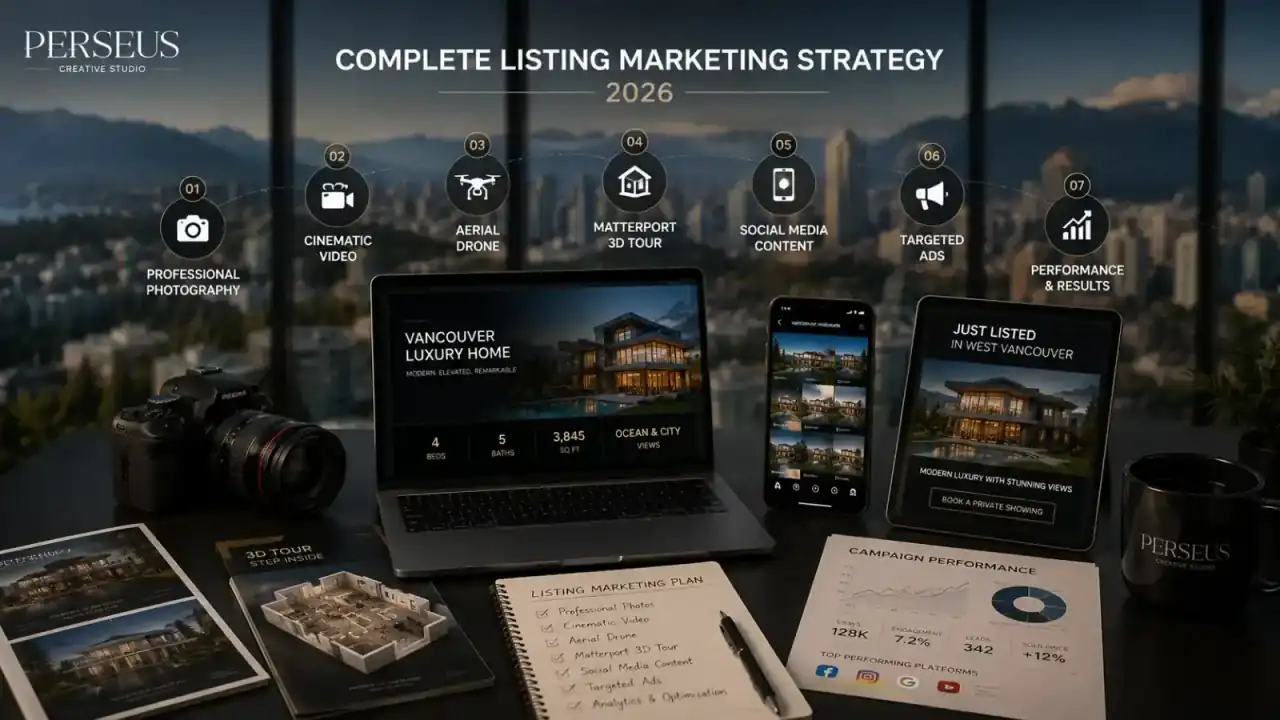
For Vancouver realtors and brokerages, the strongest campaigns in 2026 combine professional photography, videography, aerial production, 2D floorplans, 3D models, 360° tours, social content, paid advertising, and clear performance tracking. The exact mix depends on the listing. A downtown condo, a West Vancouver luxury home, a North Shore family property, a Burnaby townhome, and a Vancouver pre-sale development should not all be marketed the same way.
This guide explains how to build a complete listing marketing system: what media to create, how to plan the launch, where to publish, when to use ads, how to market developments, and how to measure what is working.
The Foundation: Visual Media That Makes the Listing Understandable
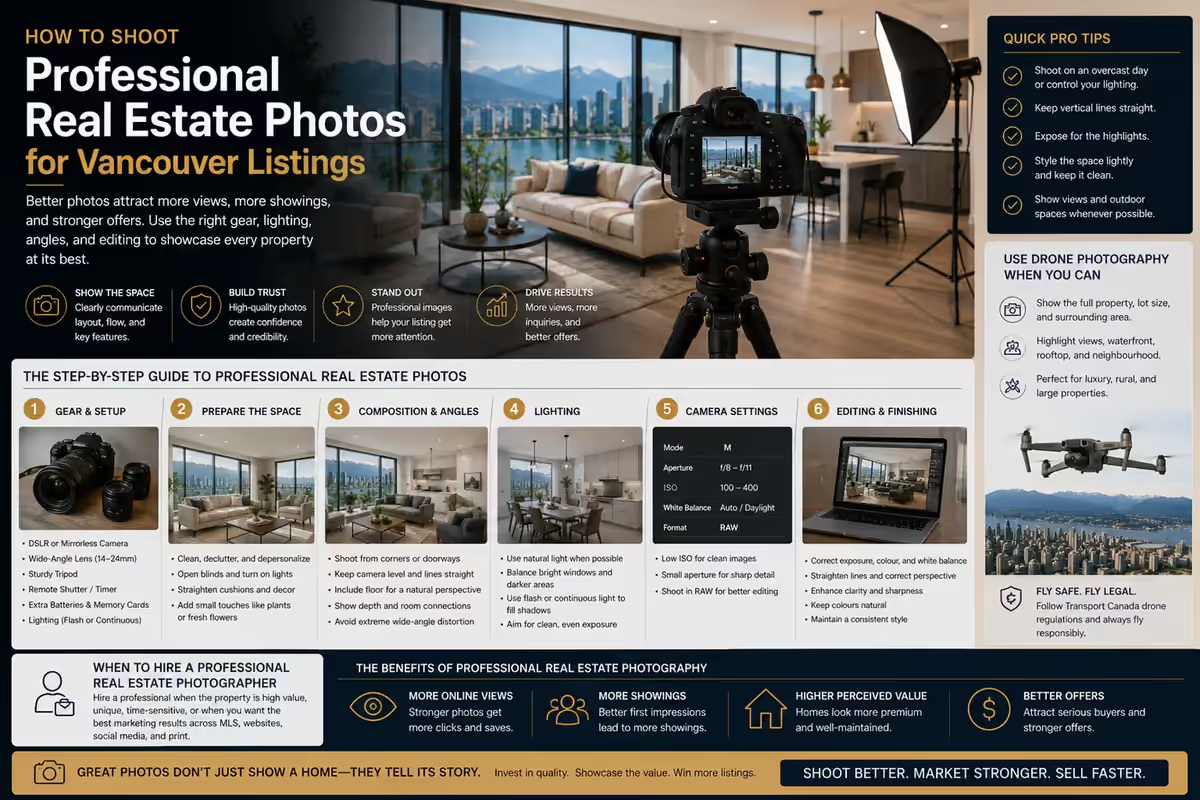
Before writing captions, launching ads, or planning reels, the listing needs strong visual assets. Visual media is the foundation of real estate marketing because buyers usually judge the property online before they experience it in person.
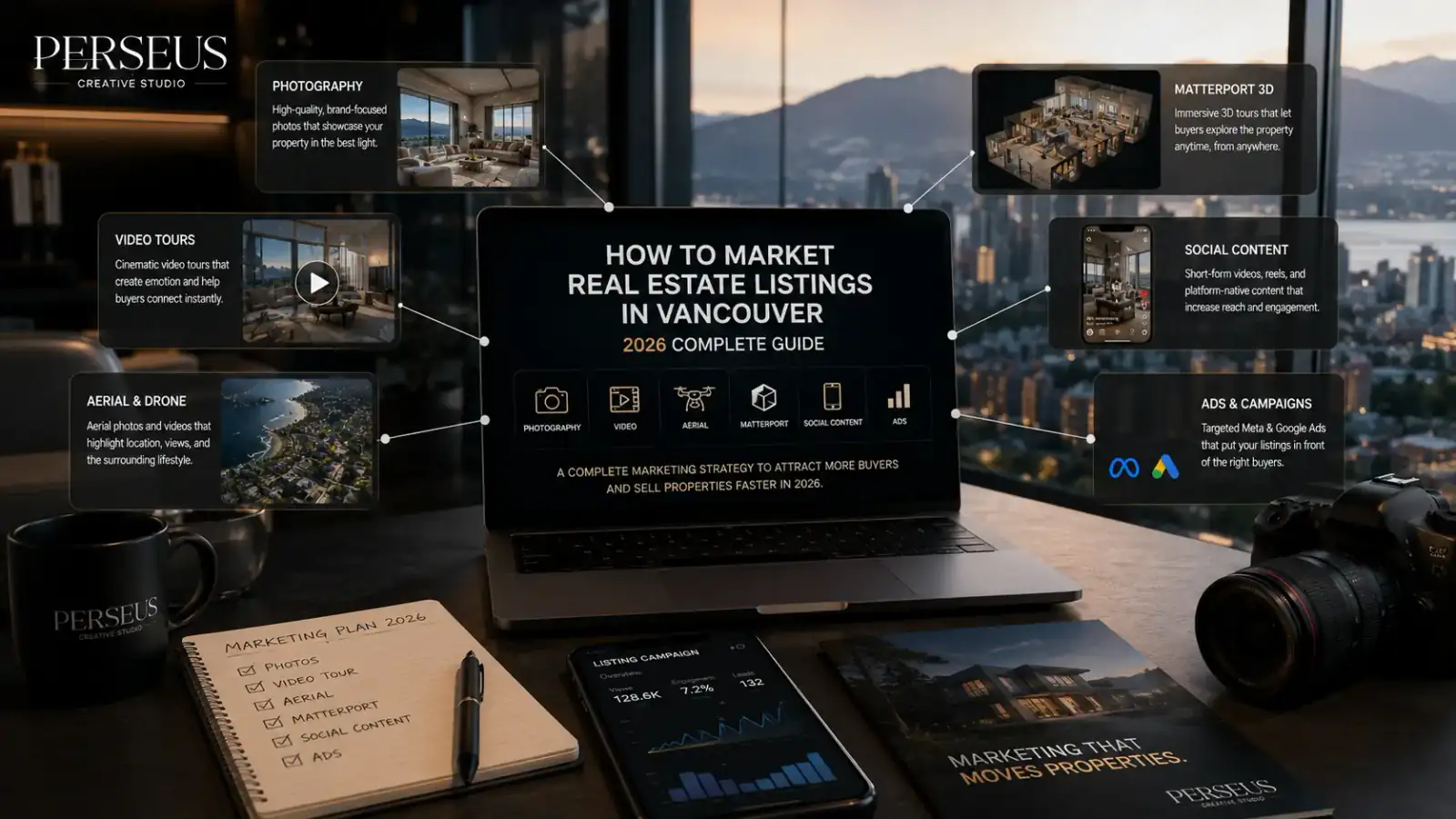
For Vancouver listings, the core media package often includes:
- Professional interior and exterior photography
- Listing videography
- Aerial production where appropriate
- 2D floorplans
- 3D models
- 360° Matterport tours
- Short-form social video
- Branded and unbranded versions of key assets
- Website-ready images and videos
- Email and ad-ready creative
Not every listing needs every asset. The media package should match the property’s price point, audience, location, timeline, and marketing objective.
A compact condo may need clean photography, a short vertical walkthrough, and a floorplan. A luxury property may need cinematic video, aerial production, twilight photography, Matterport, detail shots, social cutdowns, and a dedicated campaign page. A pre-sale project may need 3D visuals, amenity storytelling, neighbourhood content, and lead generation ads.
The strategy starts by identifying what buyers need to understand.
Why Visual Media Is the First Impression
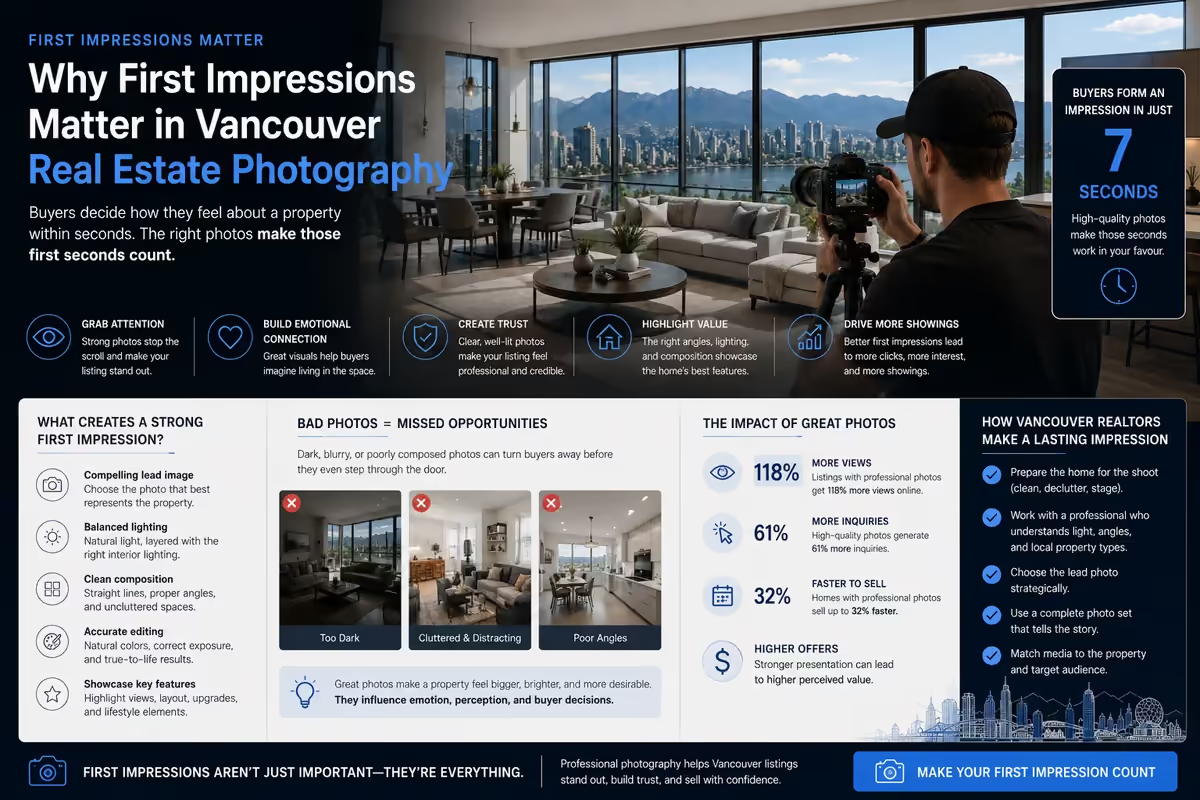
A buyer does not begin with the feature sheet. They begin with the image.
The lead photo, gallery quality, video thumbnail, and first few seconds of a listing video influence whether the buyer continues. This does not mean visuals replace pricing, location, or market knowledge. It means visual presentation affects whether the buyer gives the listing enough attention to evaluate those details.
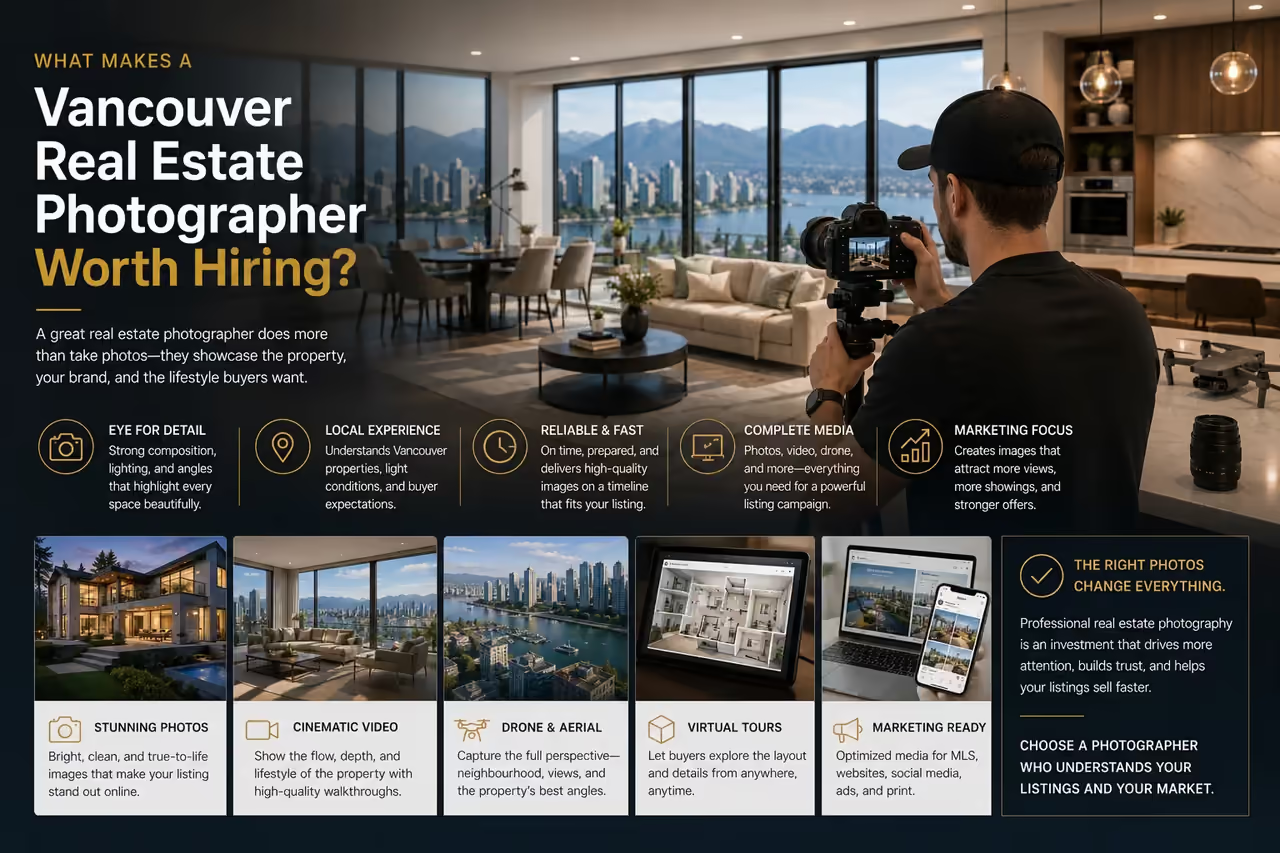
Professional photography helps buyers scan the property. Videography helps them understand flow and atmosphere. Aerial production helps them understand location and scale. Matterport and 360° tours let them explore the property more actively. Floorplans and 3D models help them evaluate layout.
Together, these assets reduce uncertainty.
Buyers want to know:
- Is the home bright?
- Does the layout work?
- How do the rooms connect?
- What condition are the finishes in?
- Is the outdoor space usable?
- What does the neighbourhood context look like?
- Is the view real and meaningful?
- Is the property worth booking a showing for?
A strong listing campaign answers these questions quickly.
Matching Media Type to Property Type
The best media package is not the biggest package. It is the right package.
A one-bedroom condo, a family home, a luxury estate, a development site, and a pre-sale project need different marketing logic.
For condos, the campaign should usually focus on layout efficiency, natural light, views, amenities, building context, and neighbourhood access. Clean photography, a floorplan, a short walkthrough video, and vertical social clips can be highly useful.
For townhomes, the campaign should explain room-to-room flow, floor levels, outdoor space, storage, parking, and family functionality. Video can help because multi-level layouts are difficult to understand from photos alone.
For detached homes, the campaign should show curb appeal, main living areas, bedrooms, outdoor space, lot orientation, basement or suite potential, garage or laneway access, and neighbourhood context. Aerial production may be useful when lot size, exterior layout, or location matters.
For luxury properties, the campaign should usually be more cinematic and more complete. Buyers expect higher-quality media. The property may need editorial photography, cinematic videography, aerial production, twilight visuals, detail shots, Matterport, and a stronger launch plan.
For development and pre-sale projects, the campaign should not rely only on listing photos. It may need 3D models, amenity storytelling, lifestyle content, neighbourhood videos, landing pages, lead forms, and paid campaigns.
The right media strategy starts with the buyer’s decision process.
Building a Consistent Visual Brand
Every listing is also a brand asset for the agent.
When a realtor uses inconsistent photography, uneven video quality, mismatched editing, or random social posts, the market sees inconsistency. When the media feels polished and structured across listings, the agent’s brand becomes more credible.
Consistency does not mean every property should look the same. It means every property should meet a clear standard.
A consistent visual brand may include:
- Similar photo editing standards
- Clean lead image selection
- Professional video pacing
- Branded and unbranded video versions
- Consistent typography on social graphics
- Similar caption structure
- Repeatable content formats
- Clear calls to action
- Professional thumbnails
- Organized listing pages
For Vancouver agents, this matters because future sellers often evaluate visible proof. They want to know whether their listing will be presented well. A consistent media standard makes that easier to demonstrate.
Planning a High-Performing Vancouver Listing Campaign
A listing campaign should be planned before launch. If the agent waits until the property is already live, the campaign usually becomes reactive. Assets are created late. Social posts feel rushed. Ads are launched without enough creative. The listing loses momentum.
A stronger approach starts with campaign planning.
Before the listing goes live, define:
- The target buyer
- The property’s strongest selling points
- The main objections buyers may have
- The best lead image
- The required media deliverables
- The launch date
- The showing and open house schedule
- The social content plan
- The paid ad plan
- The email or database plan
- The performance metrics to track
The goal is to treat the listing like a campaign, not a post.
A campaign has stages. It has assets. It has timing. It has distribution. It has measurement.
Defining the Audience and Positioning
Many listing campaigns are too generic. They describe the property but do not clearly position it.
Positioning answers the question: why should the right buyer care?
A Vancouver condo might be positioned around walkability, views, efficient layout, building amenities, rental appeal, or lifestyle access. A detached home might be positioned around family function, schools, yard space, renovation quality, suite potential, or quiet street value. A luxury property might be positioned around privacy, design, architecture, entertaining, waterfront access, or view corridors.
Before production, the agent should identify:
- Who is the most likely buyer?
- What does that buyer care about?
- What makes this property different from alternatives?
- What should the media communicate first?
- What details need to be clarified?
- What objections should the campaign reduce?
This positioning shapes the creative direction.
If the main value is the view, media should capture the view properly. If the main value is layout, the video and floorplan matter. If the main value is location, neighbourhood content and aerial visuals become more important. If the main value is renovation quality, detail photography and slower video pacing may be needed.
Mapping Assets to the Buyer Journey
A good listing campaign uses different assets for different stages of attention.
At the awareness stage, buyers may only see a photo, short video, or ad. The asset needs to be clear and attention-worthy.
At the consideration stage, buyers want more detail. They may explore the listing gallery, watch a longer video, check the floorplan, view the Matterport tour, or read the description.
At the decision stage, buyers may book a showing, ask questions, attend an open house, compare alternatives, or return to the listing multiple times.
Each stage needs a different type of content.
Awareness assets may include:
- Strong lead photo
- Short vertical video
- Aerial reveal
- Listing teaser
- Open house story
- Instagram carousel
- Paid ad creative
Consideration assets may include:
- Full photo gallery
- Listing video
- 2D floorplan
- 3D model
- Matterport tour
- Website listing page
- Neighbourhood context content
Decision-stage assets may include:
- Showing schedule
- Open house content
- Email follow-up
- Agent walkthrough video
- Feature breakdown
- FAQ content
- Retargeting ads
When these assets connect, the campaign feels more complete.
Pro Tips Before Launch
A stronger campaign starts before the public launch.
Use these practical steps:
- Confirm the strongest selling points before the shoot.
- Prepare the property for photography and video.
- Decide whether aerial production adds real value.
- Capture vertical video during the same production window.
- Create both branded and unbranded assets when needed.
- Select the lead image intentionally.
- Write captions before launch week begins.
- Build the open house content before the open house.
- Prepare paid ad audiences and creative before the listing goes live.
- Save strong assets for future seller presentations.
The strongest agents do not wait for attention. They prepare for it.
Timeline: From Pre-Launch to Post-Sale
A listing campaign should have a timeline. The timeline does not need to be complicated, but it should give the agent structure.
The common mistake is to put all marketing effort into launch day and then stop. A better strategy distributes attention across the campaign.
A practical Vancouver listing timeline can include:
- Pre-launch preparation
- Launch week
- Momentum phase
- Open house promotion
- Retargeting
- Post-sale content
Each stage has a different goal.
Pre-Launch: 3 to 5 Days Before MLS
The pre-launch phase is about preparation.
This is when the property should be cleaned, staged, photographed, filmed, and organized for distribution. The agent should not be guessing about captions, video formats, or ad creative after the listing is live.
Pre-launch tasks may include:
- Final home preparation
- Photography
- Videography
- Aerial production
- Matterport capture
- Floorplan creation
- 3D model preparation
- Gallery selection
- Video editing
- Social content exports
- Listing description draft
- Email copy
- Website listing page setup
- Paid ad creative setup
- Open house asset planning
If possible, create all major assets before the listing goes live. This gives launch week more impact.
Pre-launch is also a good time to create teaser content. A teaser should not reveal everything. It can build anticipation around the strongest feature, coming-soon status, neighbourhood, or launch date, depending on brokerage rules and local requirements.
Launch Week: Day 1 to Day 7
Launch week is when the property needs concentrated visibility.
The goal is to create enough exposure across the right channels so buyers, agents, and interested audiences see the listing quickly.
Launch week content may include:
- MLS listing activation
- Website listing page
- Full photo gallery
- Listing video
- Instagram carousel
- Instagram Reel
- TikTok or YouTube Shorts version
- Facebook post
- Email announcement
- Google Business Profile update
- Paid ad launch
- Open house announcement
- Story sequence
- Brokerage promotion
- Agent-to-agent outreach
The content should not all be identical. Each platform should use the asset format that fits best.
A photo carousel can show room sequence. A short reel can show the strongest visual hook. A longer video can explain layout and atmosphere. A website page can hold all details in one place. Paid ads can extend reach.
Launch week should feel coordinated, not improvised.
Momentum Phase: Week 2 to Week 3
If the property does not sell immediately, the campaign should not go silent.
The momentum phase keeps the listing visible and gives the agent opportunities to reframe value. This stage is especially important when the property needs more exposure, buyer education, open house promotion, or price-positioning clarity.
Momentum content may include:
- Feature-specific posts
- Room-by-room highlights
- Neighbourhood videos
- Open house reminders
- Buyer FAQ posts
- Short clips from the listing video
- Aerial context posts
- Matterport reminder
- Paid retargeting
- Email follow-up
- Agent commentary video
The key is to avoid posting the same listing graphic repeatedly. Each post should give the audience a new reason to reconsider the property.
For example, one post can focus on the kitchen. Another can focus on the view. Another can focus on the floorplan. Another can explain the neighbourhood. Another can promote the open house.
A listing campaign should have depth.
Post-Sale Content: Optional but Powerful
Many agents stop marketing once the property sells. That is understandable, but it misses a branding opportunity.
Post-sale content can show future sellers how the agent markets property and manages results. It can also help the agent stay visible between listings.
Post-sale content may include:
- Sold announcement
- Campaign recap
- Behind-the-scenes media
- Seller-focused marketing breakdown
- Neighbourhood reflection
- Agent commentary on the process
- Short testimonial, where appropriate
- Portfolio update
- Listing presentation example
Avoid making unsupported claims. Do not imply guaranteed outcomes. Do not share private details without permission.
The best post-sale content focuses on process, professionalism, and marketing standard.
Where to Publish a Vancouver Listing
A strong listing campaign should appear across multiple channels. The exact distribution plan depends on the property, brokerage rules, seller preferences, and agent strategy.
Common publishing channels include:
- MLS
- Brokerage website
- Agent website
- Property landing page
- Realtor.ca or relevant portals
- TikTok
- YouTube
- YouTube Shorts
- Google Business Profile
- Email newsletter
- Paid search ads
- Paid social ads
- LinkedIn, when the audience is appropriate
- Agent-to-agent networks
- Print or PDF feature sheets
The goal is not to post everywhere without strategy. The goal is to make the listing visible where the likely buyer, seller, or referral audience is already paying attention.
Optimizing MLS and Real Estate Portals
MLS and portal visibility starts with the basics.
A strong listing should include:
- Clear lead photo
- Complete photo gallery
- Accurate property details
- Strong description
- Proper room and feature information
- Floorplan where available
- Video link if supported
- Virtual tour or Matterport link if relevant
- Clear showing instructions
- Open house details
- Consistent branding where permitted
The photo order matters. Buyers should not feel confused by the gallery. Start with the strongest image, then move logically through the property.
The description should not repeat generic phrases. It should explain the property’s specific value.
Instead of saying “beautiful home in a great location,” explain what makes the location useful. Is it near parks, transit, waterfront, schools, shopping, or a specific neighbourhood feature? Instead of saying “spacious layout,” explain what works about the floorplan.
Good listing copy supports the visuals. It should clarify, not exaggerate.
Using Instagram, TikTok, and YouTube for Listings
Social media is useful because it gives the listing more touchpoints beyond the portal.
Instagram can support carousels, Reels, Stories, open house reminders, neighbourhood content, and agent commentary.
TikTok can support short tours, buyer education, listing hooks, neighbourhood clips, and quick explanations.
YouTube can support full listing videos, Shorts, neighbourhood guides, agent education, and evergreen content.
For Vancouver realtors, social content should be built around clarity. A short video should answer one question or show one compelling part of the listing.
Examples include:
- “A quick look inside this Kitsilano condo”
- “The view is the real story here”
- “Three details that make this layout work”
- “Why this home’s outdoor space matters”
- “A 20-second tour before the open house”
- “What buyers should notice about this floorplan”
The content should not feel like random posting. It should connect to the listing campaign.
See Real Estate Video Marketing in Action
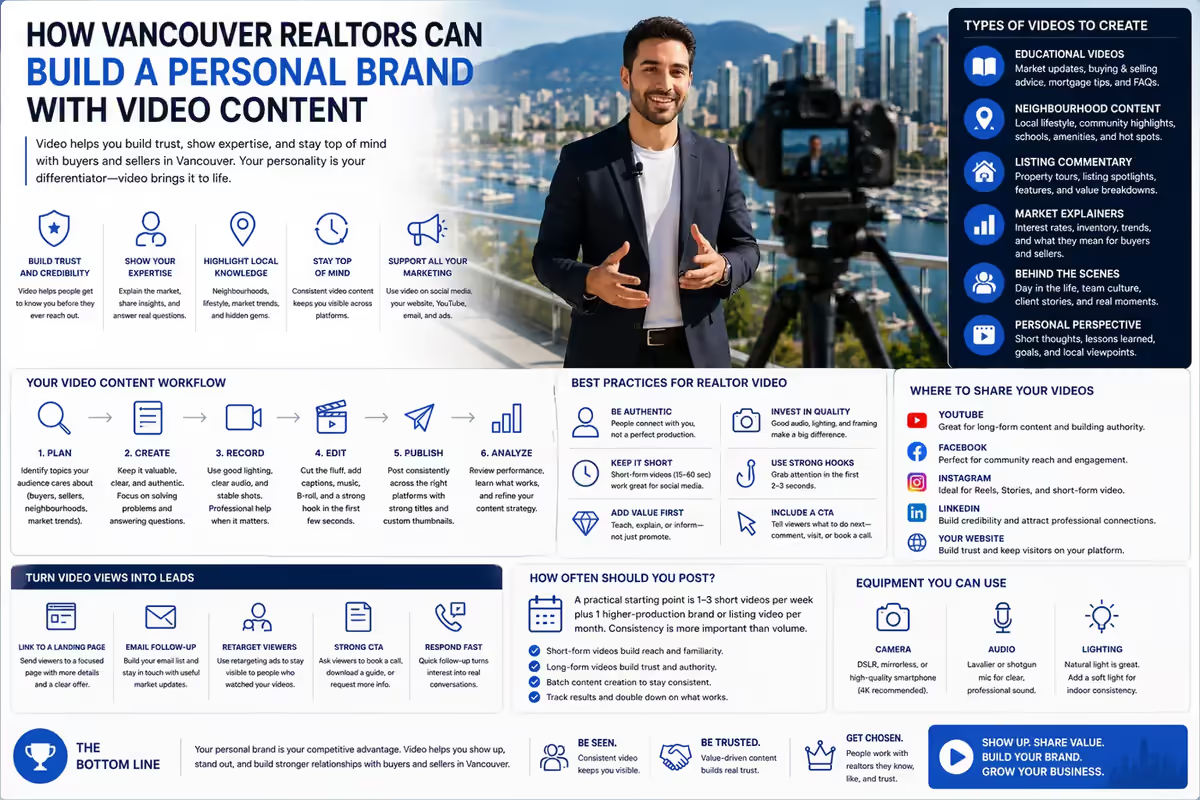
Video helps buyers understand flow, setting, and atmosphere faster than static content alone. It also gives agents stronger assets for social media, websites, email campaigns, and paid advertising.
For listing marketing, the point is not only to create a beautiful video. The point is to create a video that supports buyer understanding and gives the agent more content to distribute.
Short-Form Content: The 2026 Listing Multiplier
Short-form video is one of the most practical ways to extend a listing campaign.
A full listing video may be useful on YouTube, a website, or a property page. But a campaign also needs shorter content for mobile platforms.
One listing can produce:
- A 15-second exterior reveal
- A 20-second kitchen highlight
- A 30-second walkthrough
- A view-focused clip
- An open house reminder
- A neighbourhood clip
- An agent commentary video
- A feature breakdown
- A “three reasons to see this home” clip
Short-form content gives the listing more chances to be seen. It also keeps the agent active during the campaign.
The key is not volume alone. The content should be useful. Each clip should have a clear purpose.
Retargeting and Paid Ads for Extra Reach
Paid ads can help when the listing needs additional reach or when the agent wants to build a more structured funnel.
Meta Ads can be useful for visual listing promotion, open house campaigns, neighbourhood targeting, and retargeting people who engaged with videos or social content.
Google Ads can be useful for search-driven intent, branded searches, property landing pages, and broader lead generation campaigns.
LinkedIn Ads are usually not the first channel for standard residential listings, but they may be useful for certain development, commercial, investor, luxury, or brokerage-level campaigns.
Paid ads should not be used as a substitute for weak creative. Strong media improves ad performance because the ad needs something worth clicking, watching, or saving.
A basic paid strategy may include:
- Launch-week awareness campaign
- Open house promotion
- Video view campaign
- Retargeting campaign
- Website visitor retargeting
- Lead form campaign
- Neighbourhood-specific content promotion
The budget should match the listing and the objective. Not every property needs a large ad spend. Some listings need only focused support. Others may benefit from a fuller campaign.
Suggested Retargeting Audiences
Retargeting is useful because it reaches people who have already shown some level of interest.
Potential retargeting audiences may include:
- Website visitors
- Listing page visitors
- Video viewers
- Instagram and Facebook engagers
- People who saved or interacted with content
- Email clickers, where tracking is available and compliant
- Past lead form openers
- Lookalike-style audiences where platform rules permit
- Neighbourhood content viewers
- Open house promotion engagers
The creative should match the audience stage.
A cold audience may need the strongest property hook. A retargeted audience may need a floorplan reminder, open house date, Matterport link, feature breakdown, or agent explanation.
Retargeting should be relevant, restrained, and compliant with platform policies.
Google Ads for Real Estate Listings
Google Ads can support listing marketing when search intent exists. This is especially useful for neighbourhood searches, luxury property campaigns, pre-sale projects, branded development searches, and lead generation.
For individual listings, Google Ads may work best when connected to a landing page with strong visuals, clear details, and a lead form.
Useful campaign types may include:
- Search campaigns for neighbourhood or property-related terms
- Branded campaigns for agents or developments
- Display retargeting
- YouTube campaigns using listing video assets
- Performance-focused landing page campaigns
The landing page matters. Sending paid traffic to a weak or incomplete page can waste budget.
A good landing page should include:
- Strong hero image or video
- Core property details
- Photo gallery
- Listing video
- Floorplan
- Matterport or 360° tour if available
- Neighbourhood context
- Showing or inquiry form
- Agent contact details
- Clear call to action
Google Ads should be used with tracking so the agent can see what happens after the click.
Meta Ads for Listing Campaigns
Meta Ads can be useful because real estate content is highly visual. Facebook and Instagram support images, carousels, video, lead forms, and retargeting.
For listing campaigns, Meta Ads may be used to promote:
- Listing launch
- Open house
- Video tour
- Neighbourhood feature
- Lead magnet
- Seller marketing examples
- Agent brand content
- Pre-sale interest campaigns
Creative variation matters. A single ad may not communicate the full property. Test different hooks: the kitchen, the view, the price point, the neighbourhood, the floorplan, the open house, or the lifestyle.
For Vancouver realtors, Meta Ads should be treated as a distribution tool. They amplify the content. They do not replace good content.
LinkedIn Ads for Select Real Estate Campaigns
LinkedIn Ads are usually more expensive than consumer social ads, so they should be used carefully.
They may be useful for:
- Commercial real estate campaigns
- Development marketing
- Investor-focused campaigns
- Luxury brokerage positioning
- Recruitment campaigns
- Professional audience targeting
- Brand awareness for brokerages
- Pre-sale campaigns aimed at specific professional segments
For a standard residential listing, LinkedIn may not be the most efficient first choice. For a development, commercial asset, or investor-driven campaign, it may have a role.
The key is audience fit.
Do not use LinkedIn because it sounds premium. Use it when the target audience is actually there.
Marketing Vancouver Developments and Pre-Sales
Pre-sale and development marketing require a different approach from resale listings.
A resale listing can rely on actual photography and video. A development may need to sell a future experience. That requires more explanation, more trust-building, and more visual support.
Development marketing often needs:
- Brand identity
- Project landing page
- Renderings or 3D models
- Floorplan visuals
- Amenity storytelling
- Neighbourhood content
- Lifestyle video
- Aerial context
- Paid lead generation
- Email nurture
- Sales presentation assets
- Brochure or PDF materials
- CRM integration
- Tracking and reporting
The buyer needs to understand what is being built, where it is located, what lifestyle it supports, and why it is worth considering before completion.
That makes clarity essential.
Media Packages That Work for Pre-Sales
A strong pre-sale media package should show more than floorplans. It should build confidence in the project.
Useful assets may include:
- 3D exterior renderings
- 3D interior visuals
- Amenity visuals
- Floorplan graphics
- Neighbourhood photography
- Neighbourhood video
- Aerial production
- Developer brand video
- Sales centre content
- Agent explanation videos
- Short-form social clips
- Paid ad creative
- Landing page visuals
Pre-sale buyers need a reason to trust the project. The media should support that trust by making the future property feel clear, credible, and desirable.
A polished rendering is useful. But a complete content system is stronger.
Showcasing Floorplans, Amenities, and Lifestyle
Floorplans are practical. Lifestyle content is emotional. A strong development campaign needs both.
2D floorplans help buyers evaluate layout. 3D models help them visualize the space. 360° tours or interactive experiences can help buyers understand movement and scale. Amenity visuals show what the building offers beyond the unit.
Lifestyle content helps explain why the location and project matter.
For Vancouver developments, lifestyle content may focus on:
- Walkability
- Waterfront access
- Parks
- Transit
- Dining
- Shopping
- Schools
- Views
- Community character
- Building amenities
- Design standards
The goal is not to oversell. The goal is to make the opportunity easier to understand.
Using Drone and Neighbourhood Content for Context
Aerial production can be especially useful in Vancouver development marketing because location is often central to value.
Drone footage can show:
- Site location
- Nearby parks
- Waterfront proximity
- Mountain or skyline context
- Transit corridors
- Street access
- Commercial areas
- Neighbourhood density
- Development scale
- View potential
Neighbourhood content can add another layer. A short video showing nearby cafes, parks, waterfront areas, streets, and lifestyle features can help buyers imagine the experience of living there.
For pre-sales, the property may not be finished. That makes location storytelling more important.
Matterport, 360° Tours, and 3D Models
Matterport and 360° tours are useful when buyers need interactive exploration. They allow viewers to move through a property or model space at their own pace.
For completed properties, Matterport can help remote buyers, relocation clients, and serious prospects evaluate layout before visiting.
For developments, 3D models and interactive tours can help buyers understand future spaces that do not yet exist physically.
These assets work especially well when paired with:
- Professional photography
- Listing video
- Floorplans
- Landing pages
- Paid campaigns
- Email follow-up
- Sales team outreach
Matterport and 360° tours do not replace photography or video. They serve a different role. They give buyers control.
Photography creates the first impression. Video creates movement and emotion. Matterport creates exploration. Floorplans create clarity.
Building a Listing Landing Page
For higher-value listings, developments, or campaigns using ads, a dedicated landing page can be useful.
A listing landing page gives the campaign one central destination. Instead of spreading attention across disconnected links, the agent can send traffic to a page built for conversion.
A good listing landing page may include:
- Property title and location
- Hero video or image
- Key specs
- Photo gallery
- Listing video
- Floorplan
- Matterport tour
- Aerial visuals
- Neighbourhood section
- Open house information
- Inquiry form
- Agent profile
- Contact options
- Tracking pixels and analytics
The page should load quickly, work well on mobile, and make the next step obvious.
For Vancouver realtors running paid ads, the landing page is often where campaign quality is won or lost.
Email Marketing for Listing Campaigns
Email remains useful because it reaches people who already have some relationship with the agent or brokerage.
A listing email should be clear and visual. It does not need to include every detail. It should create enough interest for the recipient to click through.
Useful listing email formats include:
- New listing announcement
- Open house reminder
- Price update
- Feature highlight
- Neighbourhood spotlight
- Sold or campaign recap
- Buyer match email
- Broker-to-broker announcement
Email subject lines should be specific, not generic. The content should include a strong image, short description, key details, and a clear CTA.
For example:
- View the listing
- Watch the video tour
- Explore the Matterport tour
- Book a private showing
- Attend the open house
- Contact the agent
Email should support the campaign, not duplicate every social post.
Google Business Profile for Realtors
Google Business Profile can support local visibility for agents and brokerages.
For listing marketing, agents can use posts, updates, photos, and service content where appropriate. This should not replace MLS, the agent website, or social media, but it can reinforce local relevance.
Useful content may include:
- New listing announcements
- Market updates
- Neighbourhood insights
- Recent media projects
- Open house posts
- Seller education
- Photography and video examples
- Service area content
Google Business Profile also supports credibility through reviews, business information, and local presence. For Vancouver realtors, this can help strengthen trust outside of social platforms.
Agent Website and SEO
A realtor’s website should not be treated as a passive brochure. It can support listing campaigns, local SEO, lead generation, and long-term brand authority.
Listing pages and supporting blog content can target local and informational queries. Neighbourhood pages can help build relevance. Media-rich property pages can improve the user experience.
Useful website content includes:
- Listing pages
- Sold portfolio
- Neighbourhood guides
- Buyer guides
- Seller guides
- Market updates
- Video library
- Blog content
- Agent bio
- Service pages
- Contact forms
- Lead magnets
The website gives the agent more control than social media. Social platforms are useful, but they are rented attention. A website is owned infrastructure.
For Vancouver realtors, combining SEO with strong listing media can create long-term benefits beyond one property.
Measuring Listing Performance
A listing campaign should be measured. Without tracking, the agent may rely only on impressions or subjective feedback.
Useful metrics include:
- Listing page views
- Time on page
- Video views
- Video watch time
- Social reach
- Social engagement
- Saves and shares
- Website clicks
- Email opens and clicks
- Lead form submissions
- Showing inquiries
- Open house attendance
- Ad cost per click
- Ad cost per lead
- Retargeting performance
- Matterport views
- Floorplan interactions, where available
Not every metric has equal value. A vanity metric may look impressive but fail to produce meaningful interest. The goal is to understand which assets and channels are helping buyers move closer to action.
What High-Performing Campaigns Have in Common
High-performing listing campaigns usually share several traits.
They are planned early. The agent knows the positioning before the media is created.
They have strong visuals. Photography, video, aerials, and supporting assets meet the property’s standard.
They are platform-specific. The same content is not forced into every format.
They are consistent. The listing is promoted beyond one launch post.
They are clear. Buyers can understand layout, features, location, and next steps.
They are measured. The agent tracks what works and improves future campaigns.
They support the agent brand. The campaign markets the property while also showing the agent’s marketing capability.
The strongest campaigns do not feel random. They feel built.
Common Listing Marketing Mistakes
Many listing campaigns underperform because of preventable issues.
Common mistakes include:
- Waiting too long to plan media
- Using weak or inconsistent photography
- Skipping video when flow matters
- Using aerial production without strategy
- Not creating vertical video
- Posting once and stopping
- Sending paid traffic to weak pages
- Ignoring retargeting
- Not using floorplans or Matterport when layout needs explanation
- Writing generic listing copy
- Choosing the wrong lead image
- Failing to track performance
- Treating every property the same
- Not saving content for future seller presentations
Most of these mistakes come from a lack of system. The solution is not always more budget. Often, it is better planning.
When to Upgrade Your Media Partner
A realtor should consider upgrading their media partner when the current process no longer supports the listings they want to win.
Signs include:
- Inconsistent photo quality
- Slow turnaround
- No strategy beyond capture
- Weak video editing
- No vertical content options
- Limited aerial production
- No Matterport or floorplan support
- Poor communication
- Media that does not fit social platforms
- Assets that look good but do not support distribution
- No understanding of paid ads or landing pages
- No scalable package structure
A strong media partner should understand the campaign, not only the camera.
For Vancouver agents, this matters because listing media is now part of brand positioning. If the agent wants to compete for stronger listings, the marketing standard needs to match.
Real Estate Video Examples for Campaign Planning
A listing video can act as the central asset for a campaign. It can be published on YouTube, embedded on a website, cut into short social clips, used in email, and repurposed for ads.
When planning video, think beyond the final full-length edit. Ask what other assets can be created from the same production: vertical clips, teaser edits, agent commentary, aerial cutdowns, open house content, and website hero sections.
How Perseus Creative Studio Helps Vancouver Realtors Market Listings
Perseus Creative Studio helps Vancouver real estate agents, brokerages, developers, and property-focused businesses create media and marketing systems for stronger listing campaigns.
Our work connects photography, videography, aerial production, 2D floorplans, 3D models, 360° tours, Matterport, social content, paid advertising, and digital strategy. The goal is to build listing campaigns that are clear, polished, and usable across the platforms where buyers and sellers already spend attention.
For a Vancouver realtor, that may mean:
- Professional listing photography
- Cinematic property videography
- Aerial production
- Short-form vertical social videos
- Matterport and 360° tours
- 2D floorplans and 3D models
- Listing landing pages
- Meta Ads
- Google Ads
- LinkedIn Ads for select campaigns
- Retargeting campaigns
- Agent brand content
- Campaign reporting
The right package depends on the property and the objective. A condo launch, luxury home, development project, and brokerage campaign should not all use the same strategy.
Explore our real estate media and digital marketing services, or contact Perseus Creative Studio to plan your next Vancouver listing campaign.
Key Takeaway
Marketing real estate listings in Vancouver in 2026 requires more than a basic upload. A strong campaign uses professional media, strategic distribution, platform-specific content, paid amplification where useful, and clear performance tracking.
Photography creates the first impression. Videography builds flow and emotion. Aerial production adds context. Floorplans, 3D models, and Matterport improve clarity. Social content extends visibility. Paid ads can increase reach and retarget interest. Analytics help the next campaign improve.
For Vancouver realtors and brokerages, the opportunity is clear: treat each listing like a campaign, not a checklist.