Why Listing Photos Need More Than Good Lighting
Real estate photography can do more than show what a property looks like. Used strategically, it can tell buyers how the property feels, how it flows, what lifestyle it supports, and why it deserves attention.
For Vancouver realtors, this matters because buyers usually see the listing online before they book a showing. They are not only comparing square footage and price. They are comparing light, layout, mood, views, finishes, outdoor space, neighbourhood context, and whether the property feels like a fit.
That is where real estate photography storytelling becomes important.
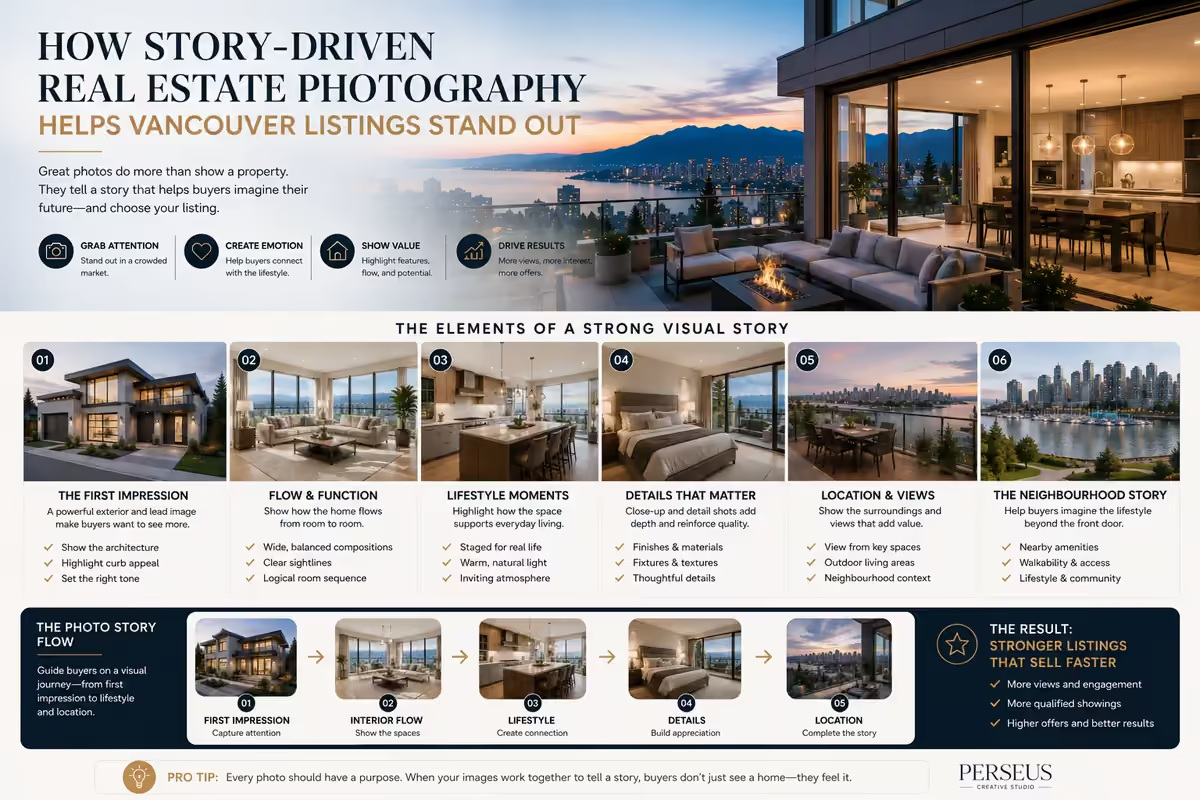
A strong photo gallery should not feel like a random collection of rooms. It should guide the buyer through the property with intention. The lead image should create interest. The main living spaces should explain flow. Detail shots should support quality. Exterior and neighbourhood images should add context. The full sequence should help buyers understand the home faster.
Professional photography does not guarantee a faster sale or stronger offers. Pricing, location, property condition, market timing, and buyer demand still matter. But a stronger visual story can improve listing presentation, reduce confusion, and give agents better assets for MLS, websites, social media, email, and seller marketing.
Quick Answer
Real estate photography storytelling is the practice of using listing photos to communicate a property’s layout, lifestyle, mood, location, and strongest selling points. For Vancouver listings, this often means combining strong composition, natural light, exterior context, detail shots, neighbourhood visuals, and a logical photo sequence that helps buyers understand the home before a showing.
What Storytelling Means in Real Estate Photography
Storytelling in real estate photography does not mean inventing a narrative. It means identifying what makes the property valuable and presenting that clearly through images.
The story might be about a bright downtown condo with strong views. It might be about a family home with easy indoor-outdoor flow. It might be about a luxury property built around privacy and design. It might be about a compact Vancouver condo where every square foot works efficiently.
A story-driven gallery answers practical buyer questions:
- What is the first impression?
- How does the home flow?
- What features matter most?
- Where does the natural light come from?
- What lifestyle does the property support?
- How does the outdoor space connect to the home?
- What does the location add?
- Why should this listing be remembered?
Without that structure, listing photos can feel disconnected. Buyers may see attractive rooms but still not understand the property.
With a clear story, photography becomes a marketing asset.
Start With the Buyer, Not the Camera
Before the shoot, the realtor and photographer should understand the property’s target buyer. Different buyers notice different things.
A young professional looking at a downtown Vancouver condo may care about light, views, workspace, balcony access, building amenities, and walkability.
A family looking at a detached home may care about kitchen flow, bedroom placement, yard usability, storage, schools, and neighbourhood feel.
A luxury buyer may care about privacy, finish quality, design, arrival experience, entertaining spaces, and outdoor living.
An investor may care about layout, suite potential, efficiency, parking, and rental appeal.
The photo story should be built around the buyer’s decision process. A gallery for a compact condo should not be shot the same way as a gallery for a West Vancouver view property. A townhome should not be presented like a luxury estate. A pre-sale or development project needs different visual logic from a resale listing.
This is why media planning matters before production. A photographer can capture stronger images when the strongest selling points are clear.
Build a Visual Sequence That Feels Like a Walkthrough
The order of listing photos affects how buyers understand the property.
A strong gallery should feel like a guided walkthrough. It should introduce the property, explain the main spaces, move through the home logically, and close with supporting context.
A practical sequence might include:
- Lead image
- Exterior or strongest interior feature
- Entry or orientation image
- Main living area
- Kitchen and dining flow
- Bedrooms
- Bathrooms
- Flex spaces, office, basement, or suite
- Outdoor areas
- Views or neighbourhood context
- Detail shots that support quality
The order should change based on the property.
If the view is the main selling point, the lead image may be the living room looking toward the view. If curb appeal matters, the exterior may lead. If the kitchen is the strongest feature, it may deserve an early position. If the property is a luxury home, the sequence may need a more editorial rhythm.
The goal is not to follow one formula. The goal is to remove confusion.
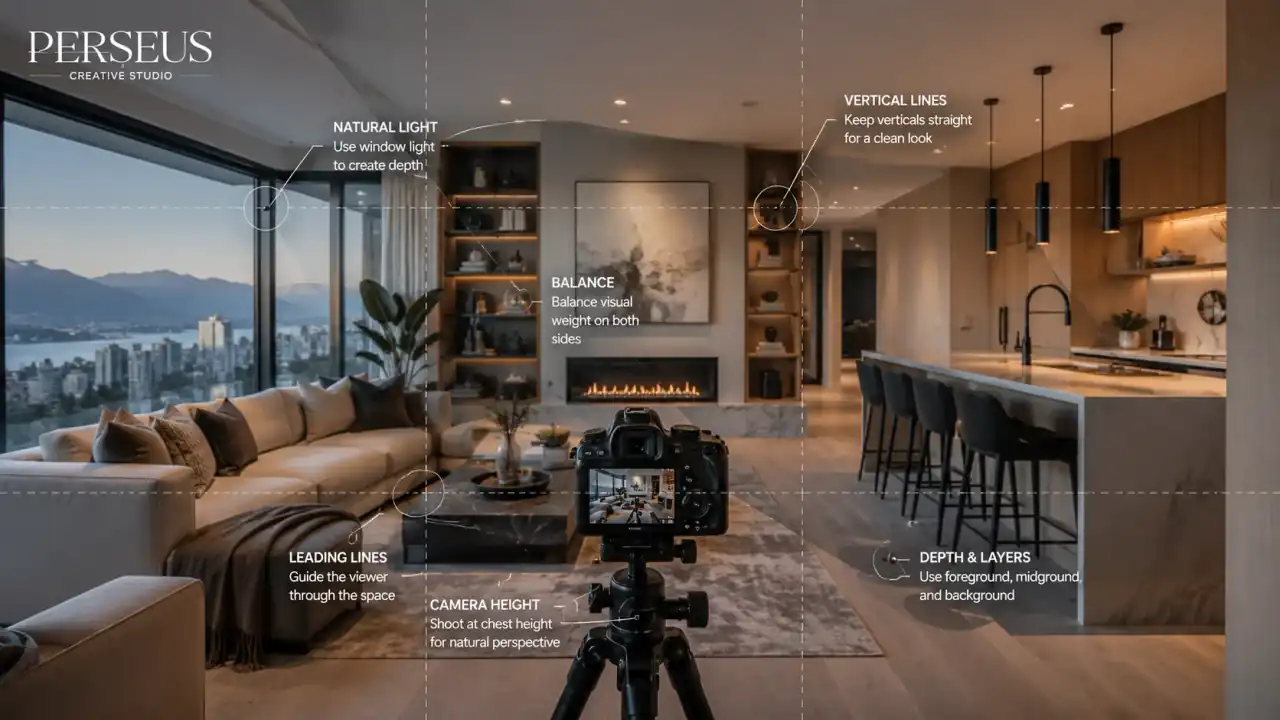
Use Composition to Guide Attention
Composition tells the viewer where to look.
In real estate photography, composition should help buyers understand the space quickly. It should highlight the main feature, show room relationships, and avoid unnecessary distractions.
Strong composition can use:
- Doorways to frame transitions
- Flooring lines to guide the eye
- Kitchen islands to lead toward living areas
- Windows to pull attention toward views
- Furniture placement to show function
- Symmetry to create order
- Negative space to make rooms feel readable
- Corners and angles to show depth
Composition is especially important in Vancouver condos, townhomes, and smaller spaces. The goal should never be to exaggerate size. The goal is to show function clearly.
A small room can still photograph well if the composition explains its purpose. A den can become a useful office. A balcony can feel like an extension of the living room. A narrow kitchen can still show flow if the angle is chosen carefully.
For a deeper breakdown of angles, camera height, and visual balance, see our guide on real estate photo composition tips for Vancouver listings.
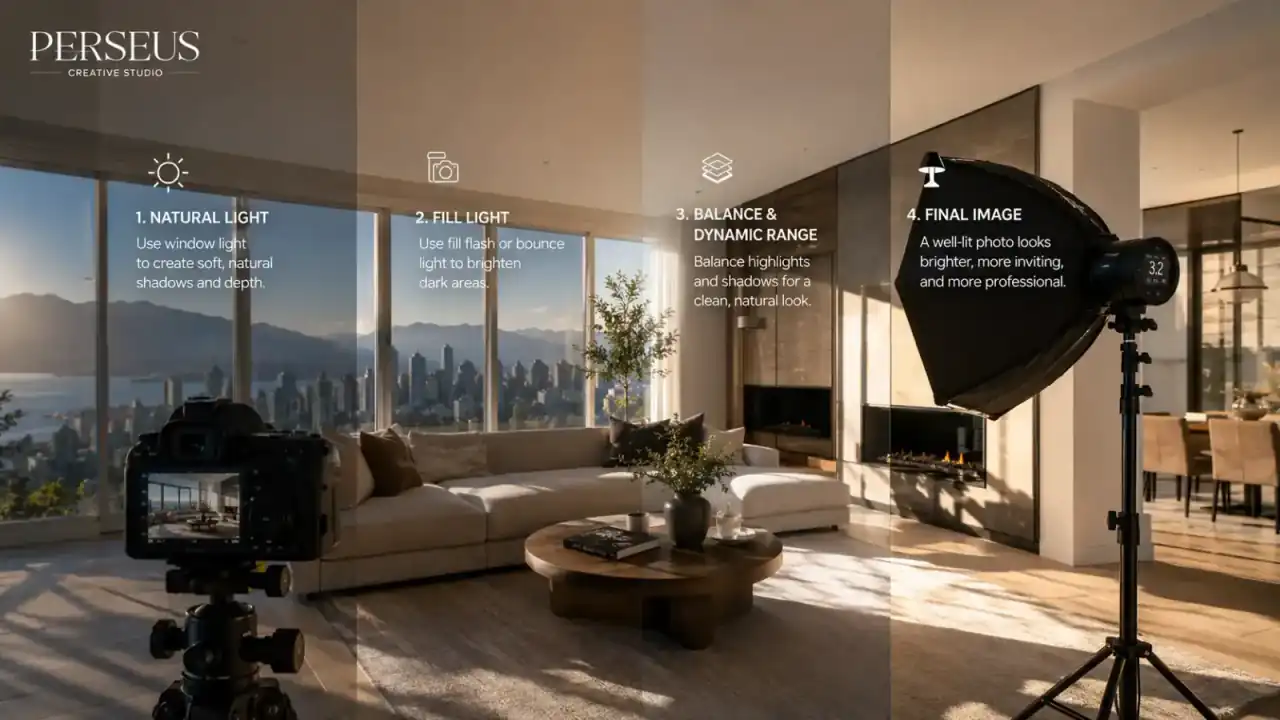
Use Light to Set the Mood
Lighting is one of the strongest storytelling tools in real estate photography.
Light can make a space feel airy, calm, refined, warm, dramatic, or functional. It also affects how buyers perceive condition, finishes, room size, and overall quality.
For Vancouver listings, lighting can be especially important because weather, window direction, tree coverage, towers, and seasonal daylight can change how a property feels.
A bright condo with mountain views needs careful window exposure. A shaded townhome needs balanced interior light. A character home may need warmth without becoming dark. A luxury property may need controlled contrast and refined mood.
Good lighting should support the story of the property.
If the home’s value is natural light, the photos should show that. If the value is evening atmosphere, twilight or warmer interior images may help. If the value is clean renovation quality, the lighting should show surfaces, materials, and finishes accurately.
For more detail on this part of the process, read our guide on real estate photography lighting for Vancouver listings.
Highlight Lifestyle Without Making the Listing Feel Staged Beyond Reality
Lifestyle photography helps buyers imagine how the home functions.
This does not mean creating fake scenes or over-styling the property. It means capturing the details that connect the space to daily life.
Lifestyle-focused real estate photos may show:
- A breakfast area with natural light
- A balcony set up for morning coffee
- A living room arranged for conversation
- A home office with a clear work setup
- A dining space ready for hosting
- A backyard or patio that feels usable
- A reading corner near a window
- A kitchen detail that suggests quality and care
The key is restraint. The property should still feel accurate and honest.
Lifestyle images work best when they support the buyer’s real decision-making. A staged coffee cup is not useful by itself. But a balcony photo that clearly shows usable outdoor space, view direction, and connection to the living room can help buyers understand value.
For Vancouver listings, lifestyle moments often connect to the city itself: views, walkability, outdoor living, natural light, neighbourhood access, waterfront proximity, and flexible work-from-home space.
Detail Shots Should Support the Story, Not Fill Space
Detail shots can make a listing feel more polished, but they need a purpose.
A strong detail image can highlight:
- Stone countertops
- Custom cabinetry
- Premium appliances
- Tile work
- Lighting fixtures
- Built-in storage
- Fireplace materials
- Flooring
- Hardware
- Architectural character
- View-facing windows
- Outdoor finishes
The mistake is using detail shots as filler. If the detail does not influence buyer perception, it may not need its own image.
Detail photography is most useful when the property has quality signals that are not obvious in wide room shots. A renovated kitchen, luxury bathroom, custom millwork, heritage detail, or designer lighting package can benefit from carefully selected close-ups.
The detail shot should reinforce the listing story. If the story is refined design, details matter. If the story is family function, detail shots should not overpower the gallery.
Exterior Photos Tell Buyers How the Home Arrives
The exterior is part of the story.
For detached homes, exterior photography can communicate curb appeal, architecture, landscaping, driveway access, privacy, yard size, and overall presentation.
For condos, exterior images can show building presence, entrance quality, lobby feel, amenities, and surrounding context.
For townhomes, exterior photos can help explain entry, street relationship, outdoor access, and how the property sits within the complex.
Exterior photos help buyers understand the property before entering. They also help set expectations.
A strong exterior story may include:
- Front elevation
- Entry area
- Landscaping
- Outdoor seating areas
- Backyard or patio
- Balcony
- Building exterior
- Shared amenities
- Street or neighbourhood context
- View orientation where relevant
The exterior should not be an afterthought. In many listings, it is the first image buyers see.
Neighbourhood Context Can Strengthen the Listing Story
Some properties are valuable not only because of the home itself, but because of where the home is.
In Vancouver, neighbourhood context can be a major part of buyer interest. A condo near the seawall, a home close to parks, a townhome near transit, or a luxury property with mountain or water access may need more than interior images.
Neighbourhood photography can help show:
- Walkability
- Nearby parks
- Waterfront access
- Street character
- Local commercial areas
- Building surroundings
- Mountain, city, or water context
- Proximity to trails or outdoor amenities
- Lifestyle features that support the listing
This should be done carefully. The listing gallery should still focus on the property. Neighbourhood images should only be included when they help buyers understand why the location matters.
CREA has discussed how platforms like Facebook, Instagram, YouTube, and TikTok give REALTORS® ways to reach geographically relevant audiences, which is why local visual content can be useful beyond the listing page itself.
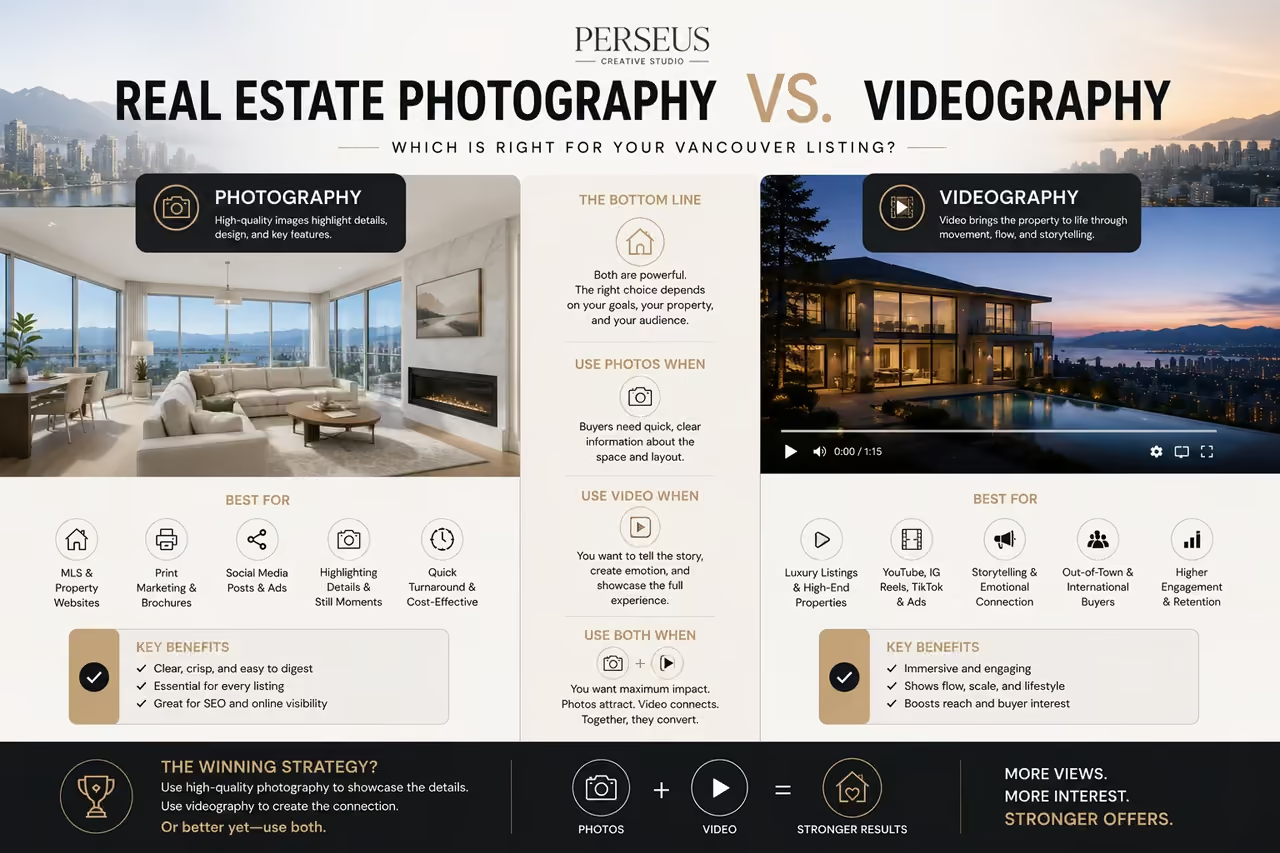
Use Photography and Video Together When the Story Needs Motion
Photography is the foundation, but some property stories need movement.
A photo can show a living room and a patio. Video can show how the living room opens to the patio. A photo can show a view. Video can reveal it through movement. A photo can show a kitchen. Video can show how the kitchen connects to dining and entertaining areas.
This is why photography and videography often work best together.
For Vancouver realtors, the decision is not always photography versus videography. The better question is whether the property story needs motion.
If the property has strong flow, views, architectural features, outdoor connection, or lifestyle value, video can extend the story photography begins. You can also compare the formats in our guide on real estate photography vs videography for Vancouver listings.
Make Photos Work Across MLS, Websites, and Social Media
A story-driven photo package should not only work inside the listing gallery. It should also support the full campaign.
The same photography can be used across:
- MLS
- Agent websites
- Brokerage websites
- Property landing pages
- Instagram carousels
- Facebook posts
- Email campaigns
- Open house promotions
- Paid ad creative
- Seller presentations
- Portfolio examples
This means the images should be planned for multiple crops and placements.
A strong MLS lead image may not be the best Instagram carousel opener. A wide interior image may work well on a website but need a different crop for social. A detail shot may be weak as a lead image but strong inside a carousel.
Google’s image SEO guidance also emphasizes that images should be supported by relevant page context, descriptive filenames, and useful alt text. For blog and listing pages, that means the surrounding content should help explain what the image represents.
Storytelling by Property Type
Different listings need different photo stories.
Condos
For condos, the story often depends on layout efficiency, natural light, views, storage, amenities, and neighbourhood access.
The photo gallery should show how the unit lives, not just what the rooms look like. The den, balcony, kitchen, bedroom, and living area should be presented in a way that explains function.
Townhomes
For townhomes, the story is usually about vertical flow, room separation, parking, outdoor space, and practical living.
Photography should help buyers understand each level. If the layout is difficult to follow, floor plans and video can support the story.
Detached Homes
Detached homes often need a broader story. Buyers may care about curb appeal, main-floor flow, bedroom layout, basement or suite potential, yard space, garage access, and neighbourhood context.
The gallery should make the home feel complete, not fragmented.
Luxury Listings
Luxury photography should communicate design, scale, privacy, finish quality, atmosphere, and arrival experience.
The story should feel refined. Detail shots, exterior photography, twilight visuals, and video can all support the listing when used carefully.
Pre-Sales and Developments
Pre-sale and development photography often needs to show lifestyle and location because the finished property may not be fully available.
Neighbourhood context, amenity imagery, 3D visuals, and campaign photography can help buyers understand the future experience.
Common Storytelling Mistakes in Real Estate Photography
Many listing galleries lose impact because the photos are technically acceptable but strategically weak.
Common mistakes include:
- Choosing a lead image without a clear reason
- Showing rooms in a confusing order
- Using too many repetitive angles
- Ignoring exterior context
- Skipping outdoor spaces
- Overusing detail shots
- Making small rooms look distorted
- Hiding layout issues instead of clarifying them
- Using lighting that does not match the property’s mood
- Forgetting neighbourhood context when location is a selling point
- Creating photos that look good individually but do not work as a sequence
The best listing photography is cohesive. Each image should add something new to the buyer’s understanding.
When Storytelling Should Stay Simple
Not every property needs an elaborate visual story.
A straightforward listing may only need clean photography, a strong lead image, a logical gallery, and a clear floor plan. Overproducing the story can make the campaign feel inefficient.
Storytelling should stay simple when:
- The layout is easy to understand
- The property is smaller and direct
- The budget is intentionally lean
- The buyer needs clarity more than atmosphere
- The listing timeline is tight
- The property does not have many lifestyle-driven features
Simple does not mean basic. A simple story can still be strong.
The question should always be: what does the buyer need to understand?
How Perseus Creative Studio Approaches Story-Driven Real Estate Photography
Perseus Creative Studio helps Vancouver real estate agents, brokerages, and property-focused businesses create listing media that supports modern property marketing.
Our approach to photography starts with the listing strategy. Before focusing on individual shots, we look at what the property needs to communicate: layout, light, design, outdoor space, view, location, lifestyle, or buyer fit.
For some listings, the right approach is clean professional photography and a clear photo sequence. For others, the story may need videography, aerial production, 2D floor plans, 3D models, Matterport, social media clips, or campaign-ready visuals.
The goal is not to make every listing look the same. A downtown Vancouver condo, a North Vancouver townhome, an East Vancouver family home, and a West Vancouver luxury property all need different visual decisions.
Explore our real estate photography and listing media services, view our real estate media projects, or contact Perseus Creative Studio to plan the right visual story for your next Vancouver listing.
Key Takeaway
Story-driven real estate photography helps Vancouver listings stand out by making the property easier to understand, easier to remember, and easier to market.
The strongest photo galleries are not random. They use composition, light, sequencing, lifestyle details, exterior context, and neighbourhood imagery to guide buyers through the property.
For Vancouver realtors, photography is not just a requirement for MLS. It is one of the most important storytelling tools in the listing campaign.