Why Buyers Judge Listings Before They Read the Description
A real estate listing usually gets judged visually before it gets judged logically.
A buyer may eventually care about price, square footage, strata fees, lot size, school catchments, renovation quality, parking, and neighbourhood details. But before they reach that level of analysis, they often react to the first image.
That reaction can happen quickly.
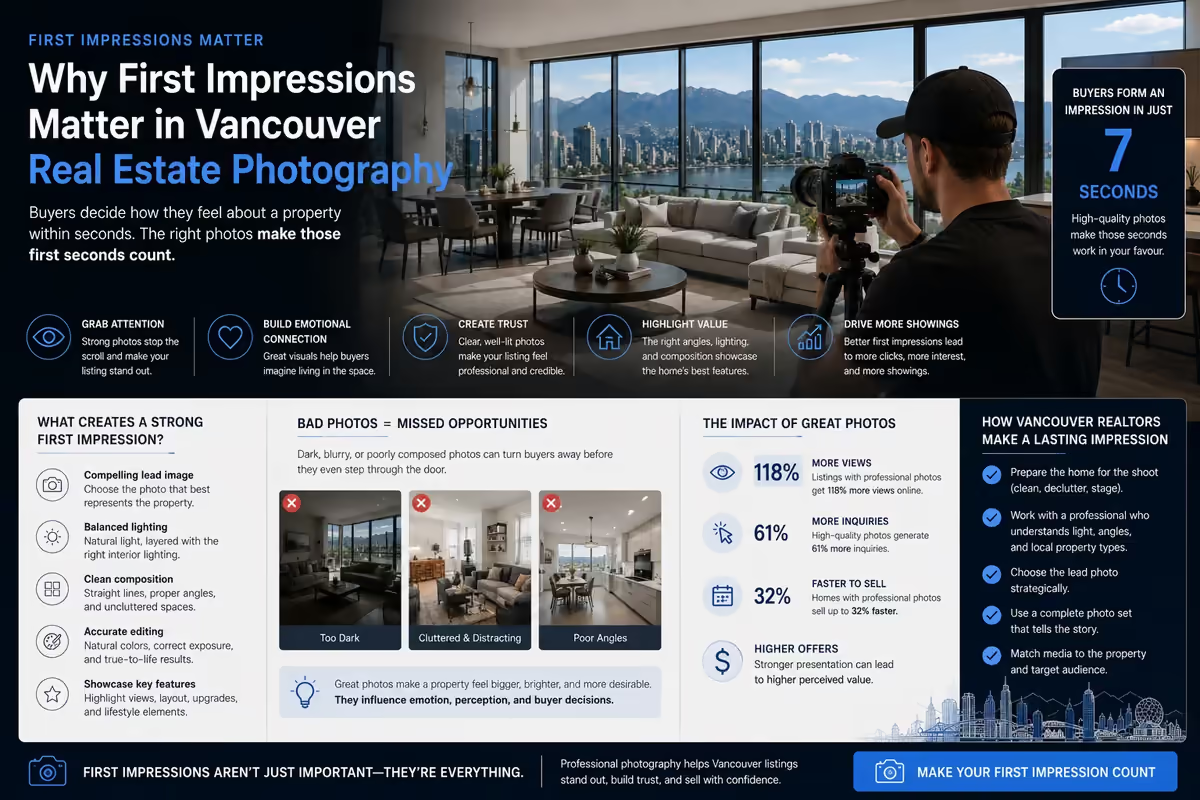
In real estate, this first impression is shaped by the lead photo, lighting, composition, cleanliness, editing, and whether the property feels clear enough to explore. If the first image creates confidence, the buyer may open the listing. If the image feels dark, cluttered, distorted, or unprofessional, the buyer may move on before understanding the home.
For Vancouver realtors, this matters because buyers compare properties across MLS, Realtor.ca, brokerage websites, agent websites, Instagram, email, and paid campaigns. The listing image is often the first point of contact.
Professional Vancouver real estate photography does not guarantee a faster sale, more showings, or stronger offers. Pricing, location, condition, timing, inventory, and buyer demand still matter. But strong photography improves how the listing is presented, and presentation affects whether buyers give the property enough attention to evaluate it properly.
Quick Answer
First impressions in real estate photography matter because buyers often decide whether to open, save, share, or ignore a listing based on the first image they see. For Vancouver listings, a strong first impression usually depends on a clear lead image, balanced lighting, professional composition, accurate editing, and a photo sequence that makes the property easy to understand.
The Psychology Behind First Impressions
First impressions are fast, and they influence how people interpret what they see next.
Psychology research by Janine Willis and Alexander Todorov found that people can form trait judgments after very brief exposure to faces. Real estate listings are not faces, and buyer decisions are more complex than a psychological lab task. Still, the underlying lesson is useful for marketing: people form quick impressions, then use additional information to confirm, adjust, or reject those impressions.
For property marketing, that means the first visual moment matters.
A buyer may not consciously analyze the lighting, camera height, or composition. They may simply feel that a listing looks bright, polished, premium, confusing, cramped, or poorly presented.
That feeling affects what happens next.
If the first image feels strong, the buyer may continue into the gallery. If it feels weak, the buyer may skip the listing. If the gallery feels consistent, the buyer may trust the presentation. If the gallery feels inconsistent or misleading, the buyer may hesitate.
The first impression is not the whole decision, but it often controls whether the buyer reaches the next step.
The Lead Image Is the First Filter
The lead image is not just another photo. It is the listing’s first filter.
It appears in search results, listing cards, social feeds, email previews, website grids, and sometimes ad creative. It has to communicate value quickly, especially on mobile.
The best lead image depends on the property.
For some Vancouver listings, the best lead image is the exterior. For others, it is the living room, kitchen, balcony, view, patio, fireplace, entry, or a dramatic architectural feature. The right choice depends on what makes the property worth attention.
A strong lead image should:
- Show a meaningful selling point
- Be easy to understand at small size
- Feel bright and clean
- Avoid clutter
- Use strong composition
- Match the property’s positioning
- Create enough interest to earn the click
A weak lead image can make the listing feel less competitive before the buyer sees anything else.
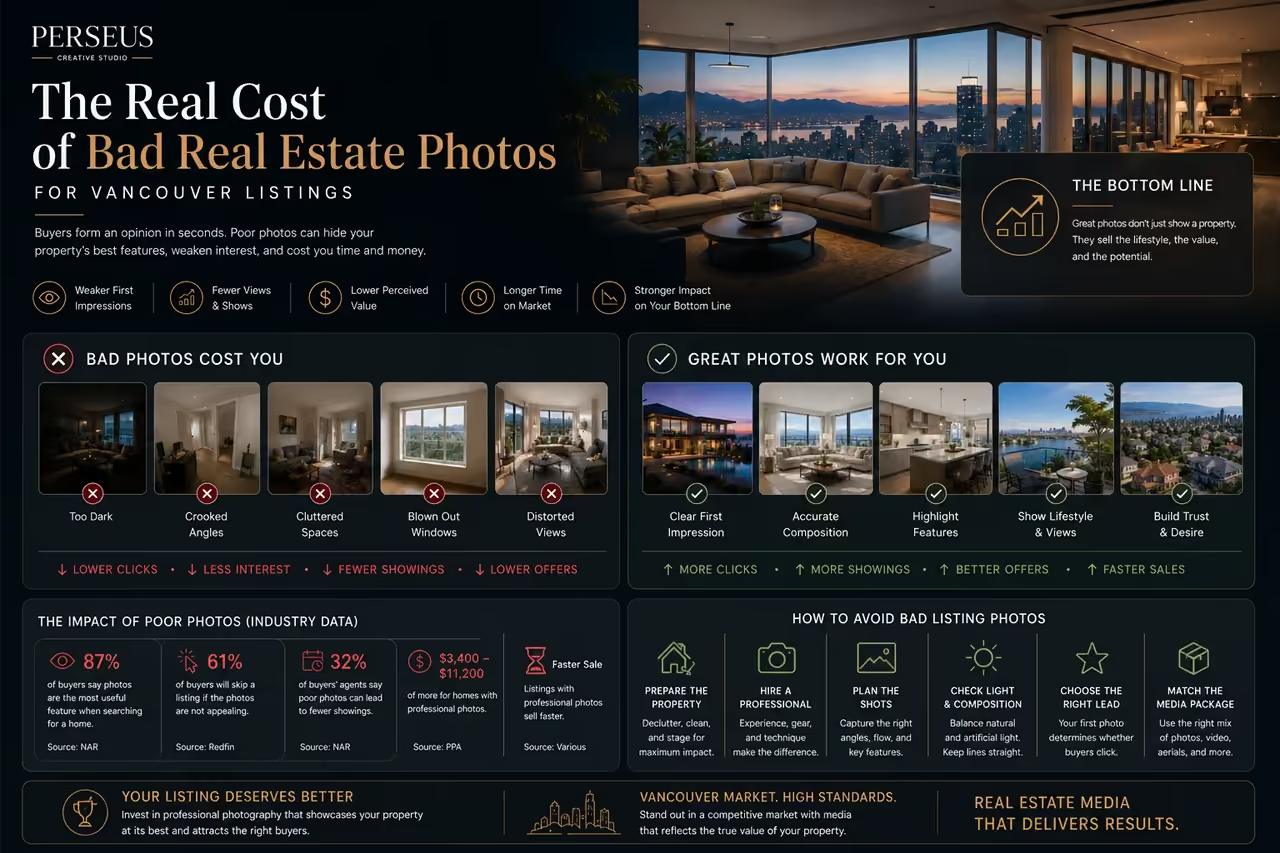
For a deeper look at how poor visuals affect listing perception, see our guide on the cost of bad real estate photos for Vancouver listings.
First Impressions Are Built Before the Shoot
A strong first impression is not created only in editing. It starts before the photographer arrives.
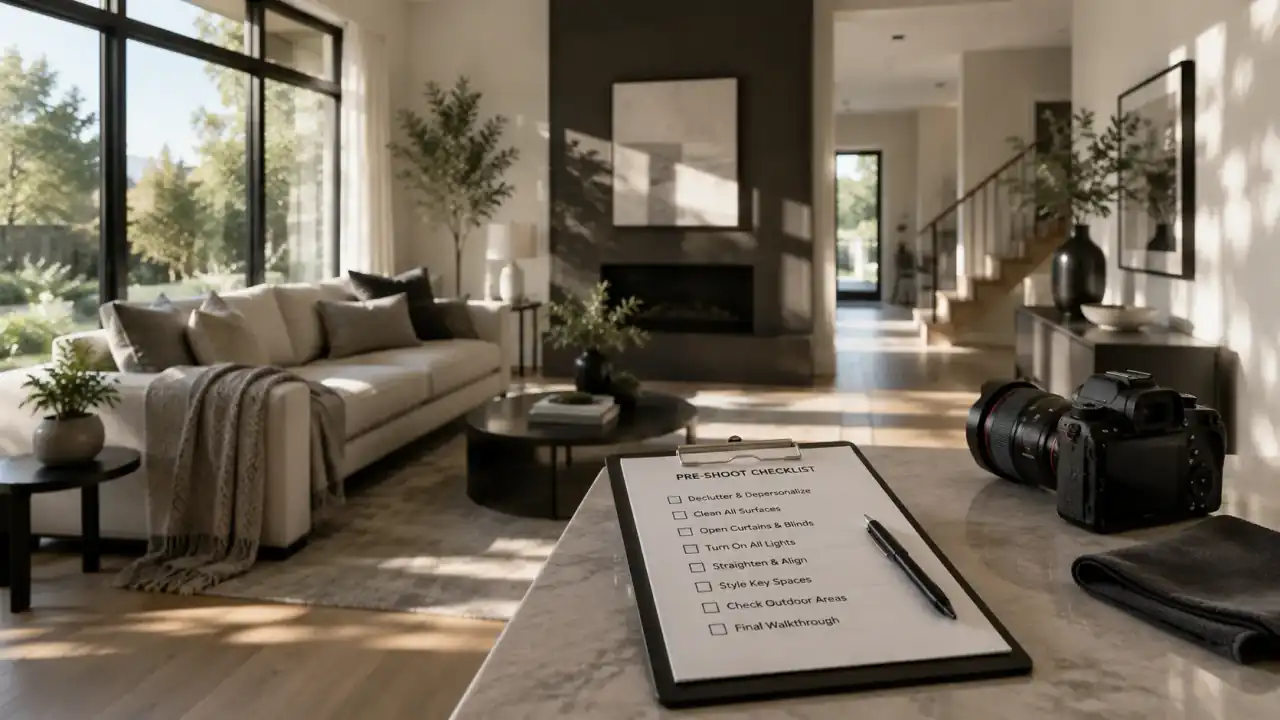
The property needs to be prepared. The realtor should know the listing’s strongest selling points. The photographer should understand what the lead image might be, what features matter, and how the final assets will be used.
Before the shoot, agents should consider:
- What is the property’s strongest visual feature?
- Who is the likely buyer?
- What should the buyer notice first?
- Does the listing need a bright, lifestyle-focused, architectural, or premium feel?
- Are views, outdoor spaces, or neighbourhood context important?
- Does the property need video, aerial production, floor plans, or Matterport?
- What image will likely become the listing card photo?
This planning helps the shoot feel intentional.
Without planning, even technically clean photos can feel generic. With planning, the media can support the listing’s actual positioning.
Lighting Controls the Emotional Read of the Listing
Lighting is one of the strongest first-impression signals.
A bright, balanced photo often makes a property feel cleaner and easier to evaluate. A dark or uneven photo can make the same property feel smaller, older, or less maintained.
Lighting affects how buyers perceive:
- Room size
- Natural light
- Cleanliness
- Finish quality
- View quality
- Mood
- Overall listing professionalism
Vancouver properties can be challenging to photograph because of overcast weather, winter daylight, shaded streets, dense urban surroundings, high-rise reflections, and mixed interior lighting. This is why lighting control is a real skill, not a small technical detail.
A strong photographer knows when to rely on natural light, when to balance interior lights, when to use flash, when to manage window exposure, and when to adjust the shoot sequence based on light.
For more detail, read our guide on real estate photography lighting for Vancouver listings.
Composition Makes the Property Easier to Understand
Composition is the way the image is arranged.
In real estate photography, composition should help buyers understand the room quickly. It should show function, flow, proportion, and the main feature without unnecessary distortion.
Strong composition often includes:
- Straight vertical lines
- Balanced camera height
- Clear room angles
- Intentional focal points
- Useful negative space
- Doorways and sightlines
- Window and view framing
- Furniture placement that explains scale
Bad composition can make a room feel awkward or confusing. Too much ceiling, crooked walls, excessive wide-angle distortion, cluttered framing, or repeated angles can weaken the gallery.
The buyer may not identify the issue technically. They may simply feel that the listing looks less professional.
For a practical breakdown, see our guide on real estate photo composition tips for Vancouver listings.
Editing Should Improve Trust, Not Break It
Editing is part of professional real estate photography, but it has to be handled carefully.
Good editing improves clarity. It balances exposure, corrects colour, straightens perspective, and keeps the gallery consistent. Bad editing can make the property feel artificial or misleading.
Common editing mistakes include:
- Overly saturated colours
- Unrealistic skies
- Excessive HDR
- Over-brightened rooms
- Inconsistent colour temperature
- Over-sharpening
- Distorted perspective
- Views that look exaggerated
Buyers need to trust that the photos represent the property accurately. If the images look too manipulated, that trust can weaken.
The strongest editing style is polished, clean, and believable.
For Vancouver realtors, this matters because buyers may see the property in person soon after viewing the listing. The photos should create confidence, not disappointment.
The Photo Sequence Shapes the Buyer Journey
First impressions are not only about the first image. They continue through the gallery.
A strong photo sequence helps buyers move through the property logically. A weak sequence makes the home harder to understand.
A clear sequence may include:
- Lead image
- Exterior or strongest interior feature
- Entry or orientation image
- Main living area
- Kitchen and dining flow
- Bedrooms
- Bathrooms
- Flex spaces or lower levels
- Outdoor areas
- Views or neighbourhood context
- Detail shots
This order should change depending on the property. A view property may lead with the view. A renovated kitchen may deserve early placement. A luxury property may need a more editorial flow. A townhome may need clearer floor-by-floor organization.
The goal is to make the listing feel easy to understand.
A buyer should not have to work hard to figure out the home.
First Impressions Differ by Property Type
Different property types need different first-impression strategies.
Condos
For Vancouver condos, buyers often care about light, layout, view, storage, balcony access, amenities, and neighbourhood convenience.
The lead image may be the living room, view, kitchen, or balcony. The gallery should explain how the unit works and whether the square footage is used efficiently.
Townhomes
Townhomes usually need clarity around levels, room separation, parking, storage, and outdoor access.
A strong first impression should make the layout feel understandable, not confusing. Photography may need support from floor plans or video.
Detached Homes
Detached homes often need a broader first impression. Buyers may care about curb appeal, yard space, main-floor flow, bedrooms, basement or suite potential, and neighbourhood setting.
The gallery should make the home feel complete and well organized.
Luxury Listings
Luxury listings need a more refined first impression. Buyers and sellers expect visual quality, careful pacing, strong details, premium lighting, and media that matches the property’s positioning.
Photography, video, aerial production, and Matterport may all play a role.
Waterfront and View Properties
For waterfront and view properties, the first impression often depends on the relationship between the home and its setting.
The media should show not only the view, but where the view is experienced from.
Video Can Extend the First Impression
Photography usually creates the first impression. Video can extend it.
A listing video can show movement, flow, atmosphere, and lifestyle. It can make a property feel more complete when the listing has strong views, open-concept spaces, indoor-outdoor connection, luxury finishes, or a neighbourhood story.
Video is especially useful for social media because short clips can create repeated touchpoints. A full listing video can also be embedded on a property page, shared by email, and used in open house promotion.
Google’s video SEO documentation explains that video pages can be supported by structured data, thumbnails, previews, and technical signals that help Search understand video content. For real estate websites, that means embedded video should be placed in a relevant page context instead of being treated as an isolated asset.
Image SEO Matters After the Photo Is Published
Listing photos and blog images do not stop being important after the shoot. They become website assets.
If the images are used on a realtor website, project page, landing page, or blog, they should be supported by basic image SEO.
Google’s Image SEO best practices explain that image discoverability depends partly on helping search engines find and understand images, as well as optimizing the page where those images appear.
For Vancouver real estate websites, this means images should be supported by:
- Descriptive filenames
- Useful alt text
- Relevant surrounding copy
- Proper page titles and descriptions
- Fast-loading image formats
- Strong page context
- Structured data where appropriate
This is one reason professional media and digital marketing should work together. Strong images are more useful when the page around them is also well structured.
Common First-Impression Mistakes Realtors Should Avoid
Many listing first-impression problems are preventable.
Common mistakes include:
- Choosing the lead image randomly
- Launching with dark or inconsistent photos
- Not preparing the home before the shoot
- Ignoring the strongest selling feature
- Using too many repetitive angles
- Overediting the gallery
- Skipping exterior or outdoor context
- Hiding views behind poor exposure
- Using photos that look distorted or misleading
- Not creating social-ready assets
- Treating media as a checklist instead of a campaign
The first impression should be planned. It should not depend on whatever image happens to be first in the folder.
When a Stronger Media Package Is Needed
Photography is the foundation, but some listings need more support.
A stronger media package may be needed when the property has:
- Strong views
- Luxury positioning
- Waterfront or neighbourhood context
- Multi-level layout
- Outdoor living
- Architectural detail
- Remote buyer interest
- Complex room flow
- Pre-sale or development positioning
- Social media campaign goals
In these cases, videography, aerial production, 2D floor plans, 3D models, Matterport, and short-form video can help extend the first impression into a stronger buyer experience.
For a broader framework, read our guide on the best real estate media for Vancouver homes in 2026.
How Perseus Creative Studio Helps Create Stronger Listing First Impressions
Perseus Creative Studio helps Vancouver real estate agents, brokerages, developers, and property-focused businesses create listing media that supports stronger digital presentation.
Our approach starts with the first impression. We look at what the buyer needs to understand first, what image should lead the campaign, how the property should be sequenced, and whether photography alone is enough or the listing needs video, aerial production, floor plans, Matterport, or social content.
For some listings, the strongest move is clean professional photography and a clear lead image. For others, a complete media package is needed to show layout, setting, flow, and lifestyle.
A downtown Vancouver condo, North Vancouver townhome, West Vancouver waterfront property, Burnaby family home, and pre-sale development should not all be presented the same way.
Explore our real estate photography and listing media services, view our real estate media projects, or contact Perseus Creative Studio to create a stronger first impression for your next Vancouver listing.
Key Takeaway
First impressions in real estate photography happen quickly. Buyers often decide whether a listing is worth exploring based on the first image, then use the rest of the gallery to confirm or reject that first reaction.
For Vancouver realtors, that makes professional photography a strategic part of the listing campaign. Lighting, composition, editing, sequencing, and lead image selection all influence how buyers perceive the property online.
Strong photos do not guarantee results. But weak first impressions can make every part of the campaign harder.