To advertise in ChatGPT, start at OpenAI Ads Manager, create an advertiser account, complete the required setup, and build a campaign for review. As of November 25, 2026, Canadian and US businesses are listed as eligible for self service access. Access does not guarantee delivery: your account must qualify for the selected audience country, your offer must meet policy, and billing and campaign settings must permit serving.
Before committing spend, prepare a clear offer, a working landing page, and a way to measure qualified enquiries or purchases. Perseus Creative Studio’s digital marketing services cover paid media, analytics, and conversion optimization, foundations that help a business assess a new channel.
ChatGPT Advertising Availability and Eligibility

Check two locations separately: where the advertiser’s legal entity is based and where the campaign may deliver. OpenAI requires the entity advertising and receiving bills to be based in a country supported for self service. Canada and the United States are both listed. Creating a login from an unsupported country does not unlock campaign access.
Ads have rolled out to eligible users in Canada and the United States. OpenAI’s October 21 expansion announcement reported availability in 89 countries, but that global footprint does not establish permission for every account to advertise internationally. Some new self service accounts are initially restricted to their home country.
Ads Manager remains a beta product. Larger advertisers can request sales support, while particular features have separate eligibility rules. Check your category before producing assets: political advertising, gambling, and alcohol promotions are disallowed; financial, legal, and healthcare services are permitted only on a limited basis with prior approval. These platform restrictions apply even when a business can legally sell its services.
How ChatGPT Ads Work
Standard ads appear below ChatGPT responses, separately identified as sponsored placements. Buying one does not buy a recommendation inside the answer. OpenAI says advertisers cannot shape, rank, or alter ChatGPT’s responses.
Ads may appear for eligible Free and Go users. Plus, Pro, Business, Enterprise, and Edu plans are free of ads, and accounts identified as under 18 do not receive ads. Do not assume an audience of business owners is reachable simply because those owners use ChatGPT.
The system considers conversational context, the landing page, ad copy, and context hints provided by advertisers. With personalization enabled, selected signals from a user’s broader ChatGPT experience can also inform relevance. Advertisers do not receive private chat histories. Messages a person deliberately sends directly to an advertiser are a separate interaction.
Organic visibility needs a different plan. Perseus’s guide to add your business to ChatGPT through Business Hub covers business profile management, rather than purchasing ad inventory.
Setting Up Your First Campaign

Start with one offer and one business outcome. A useful first test asks whether the channel brings customers you can serve at an acceptable cost. Fix a broken enquiry or checkout process before testing whether paid visits produce sales.
Ads Manager Account Setup
Have the registered business name, public brand name, website, billing details, and responsible account owner ready:
- Sign in or create an OpenAI account. If the advertiser already has an account, request an invitation rather than creating a duplicate.
- Choose whether to build an initial ad from your website during signup or skip that step and enter Ads Manager.
- Review account details carefully. Country or region, currency, and time zone cannot be changed after account creation.
- Complete billing and required verification or reviews. Check that the public Brand Name and registered Legal Name are correct.
- Invite teammates with appropriate Admin, Member, or Viewer access, then review the campaign before activation.
Build the campaign around its objective and budget, then create ad groups, which organise related ads around a shared offer or customer need. Add the creative and destination URL within each group.
Onboarding assisted by your website can create a campaign that begins serving after approval when other requirements are satisfied. If you are still preparing the launch, pause it and confirm its status. Review the billing currency shown in your account; a Canadian business should not assume every quoted dollar amount is CAD.
Campaign Objectives and Budgets
The documented objectives are Views, Clicks, and Conversions. Views buys impressions, meaning ad displays; Clicks focuses on website traffic. Conversions optimizes towards a supported action, such as a purchase or lead submission, after tracking is configured. A business goal like acquiring profitable customers still requires evaluation beyond the selected platform objective.
For conversion optimization, choose a supported standard event. Custom events are not currently supported for that objective, and changing the selected event requires a new campaign.
Total campaign budgets control total campaign spend. Daily budgets are averages over a budget week running from Sunday to Saturday in the account’s time zone. Spend can reach twice the daily amount on one day. The weekly limit is seven times the daily budget, with proration when budgets change.
The published minimum daily budget is CAD 25 for accounts billed in CAD and USD 25 for accounts billed in USD. These minimums depend on the billing currency and are not equivalent values or guarantees of useful results.
Set your test’s spending limit from what you can afford to learn. Define a qualified lead before launch, decide who will follow it up, and record the cost ceiling that would make another test worthwhile.
Ad Creative and Landing Pages
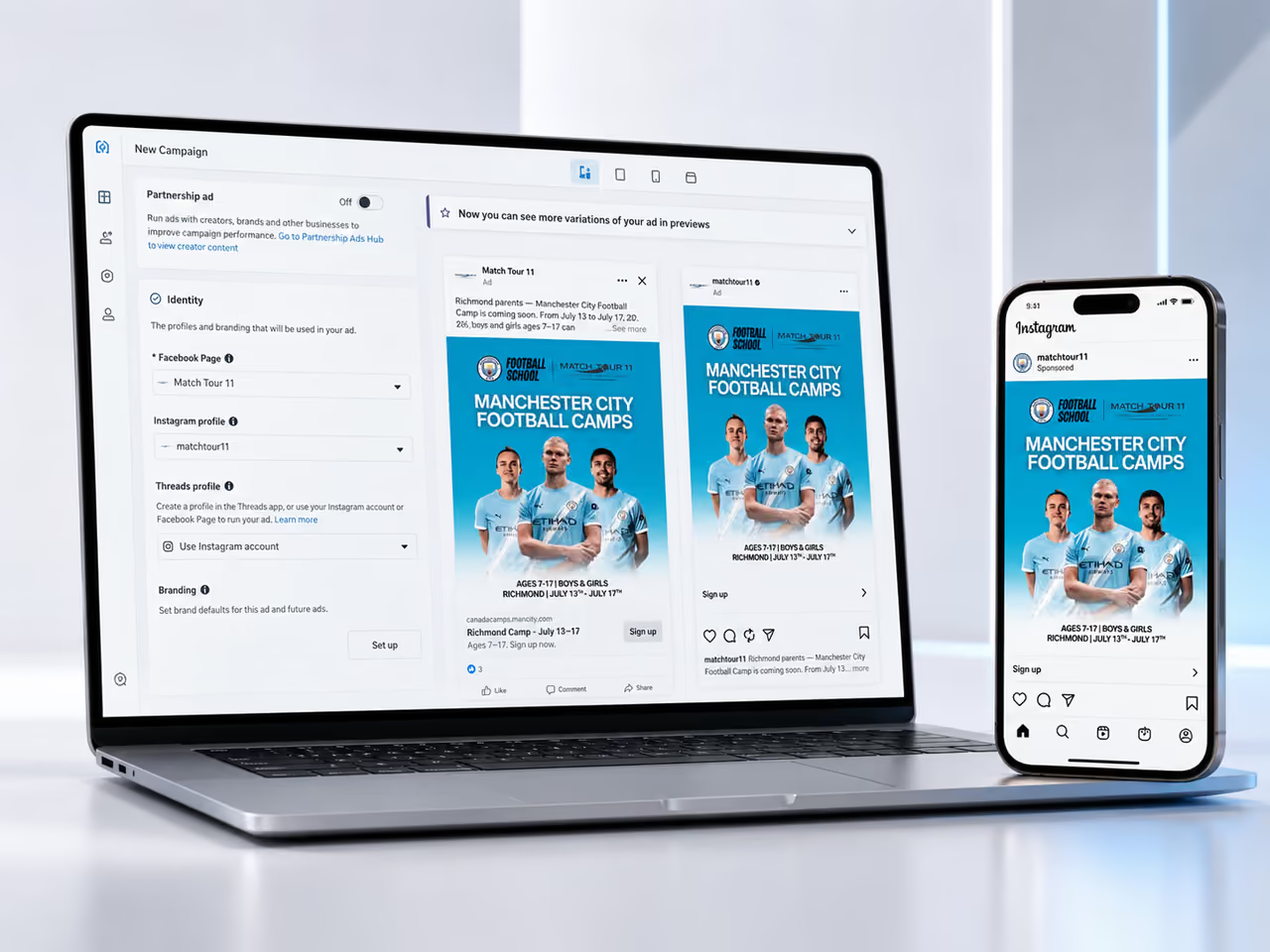
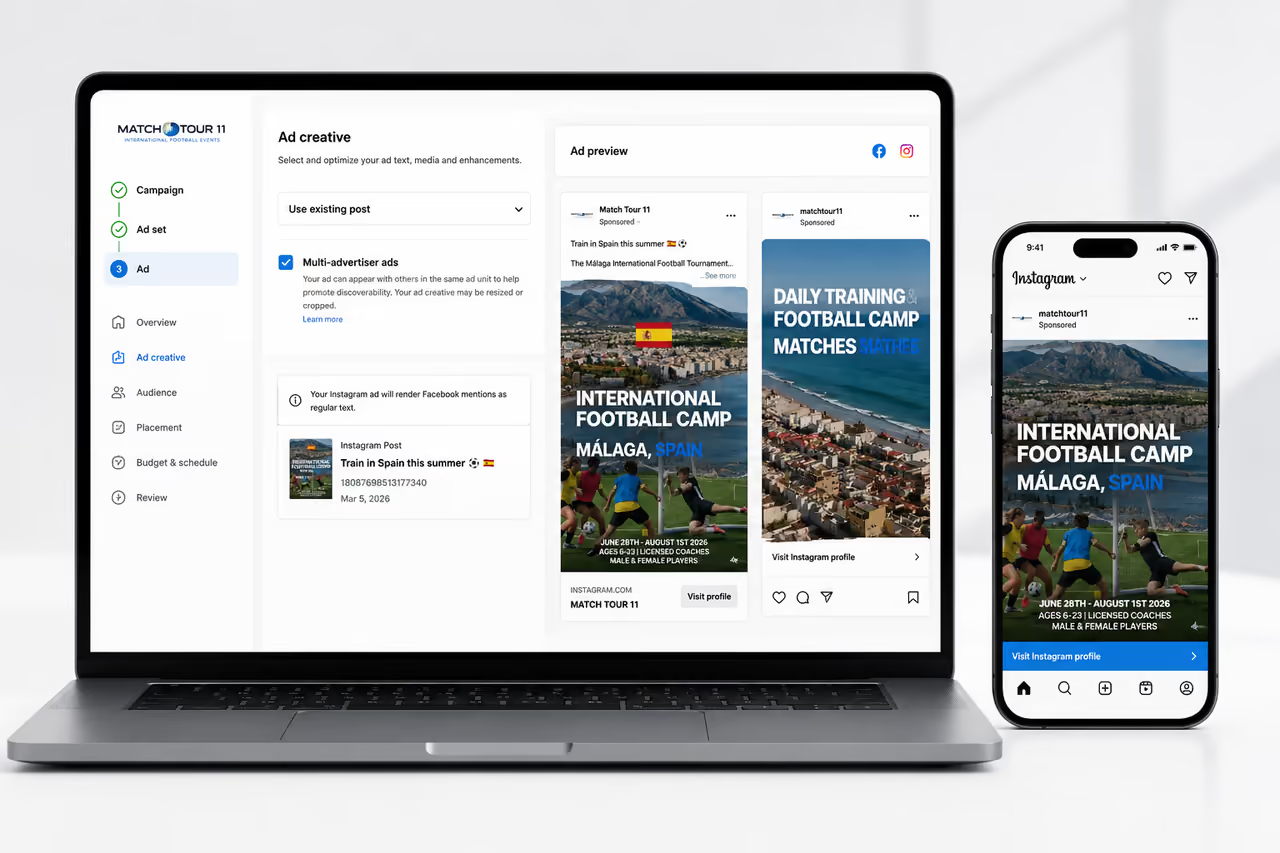
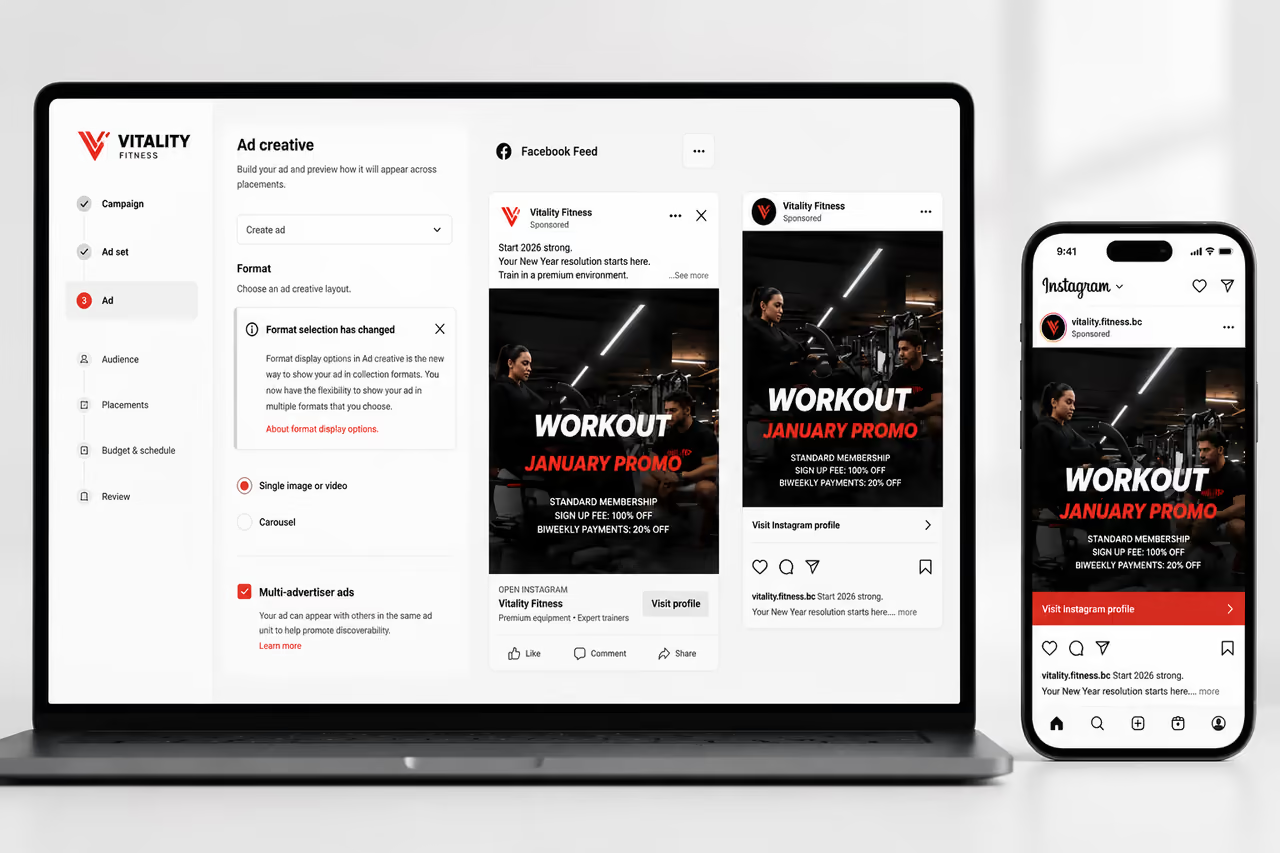
Standard campaigns support ads with a single image and a format with multiple images currently offered as an open beta. Ads with a single image can use a square compact image or a wide hero image. Carousels use four to six square images sharing one destination.
The headline limit is 50 characters and the description limit is 100. Recommended dimensions are 1200 × 1200 pixels for square assets and 1200 × 675 for landscape assets. For device uploads, current troubleshooting guidance specifies PNG or JPG.
Consider this hypothetical example for a Canadian retailer selling desk organisers:
- Headline: Make room to work
- Description: Modular desk organisers for small home offices.
The destination should show those organisers, their dimensions, prices, and actual availability. If the campaign reaches US customers, explain shipping coverage, checkout currency, and returns before purchase. Do not imply service across borders that the business cannot provide.
A focused product or campaign landing page should continue the ad’s promise. OpenAI reviews creative and destinations for policy compliance. Test the complete URL, including tracking parameters and redirects. Allow OAI-AdsBot for landing page validation and check firewall rules or rules protecting against bots; OpenAI also recommends allowing OAI-SearchBot.
OpenAI is separately testing visual ads during image generation. That limited test should not be confused with general access to the standard carousel format.
ChatGPT Ad Targeting
Relevance and delivery controls serve different purposes. Descriptions help the system understand an offer; location settings determine where a campaign is eligible to appear. You need both accurate relevance information and appropriate controls.
Writing Effective Context Hints

Context hints are additional details entered at the ad group level to explain what you offer, who it helps, or when it is useful. They can connect a product feature to a customer situation that the ad alone does not explain.
For the hypothetical retailer selling desk organisers:
- Weak hint: Desk, office, storage, best organisers.
- Improved hint: Modular organisers for people fitting stationery and charging cables onto a small desk in a home office.
The improved version describes a practical need and a relevant use case. It is useful only if the product actually suits that situation. Add different hints when they contribute distinct, truthful information; repeating the headline adds little.
Hints are not exact match keywords. They do not guarantee particular conversations, exclude audiences, enforce geography, or control schedules. “Available in Vancouver” describes service coverage. It does not replace a geographic restriction. Update hints when products, prices, or availability change.
Location and Audience Settings
Country targeting is supported. Standard campaigns can also use supported regions, cities, markets, and postal codes where available. New campaigns using product feeds have geographic targeting and exclusions at the country level only. Platform settings can distinguish desktop web, Android app or web, and iOS app or web.
Custom audiences can include or exclude matched customer or prospect lists. Inclusion requires at least 25,000 matched users; smaller audiences can be used for exclusion. Uploaded records are not the same as matched users, and advertisers cannot inspect individual matches. Review the requirements for data use before uploading a list.
For an advertiser based in Canada planning US delivery, confirm that the account can advertise beyond Canada, explicitly include the United States in campaign locations, and review exclusions. Selecting the US does not override a restriction to the home country. OpenAI does not publish the local spending or payment threshold that unlocks broader access.
Check fulfilment, support, and billing arrangements before funding that test. Do not infer targeting based on sensitive traits or access to individual conversation histories from the platform’s contextual matching.
ChatGPT Advertising Costs and Bidding
There is no reliable universal price for reaching a ChatGPT customer. Auction conditions, relevance, objective, and account settings affect what you spend and receive.
CPM means cost per thousand impressions. CPC means cost per click. Views campaigns use impression billing; Clicks campaigns use billing for valid clicks. Eligible conversion campaigns can use billing based on clicks or impressions while optimizing towards conversions. Choosing Conversions does not mean you pay only when someone converts.
Current bidding guidance distinguishes:
- Intelligent bidding: The system adjusts bids towards your outcome within budget.
- Target CPC: An average goal for cost per click in eligible click campaigns.
- Target CPA: An average goal for cost per action in eligible conversion campaigns.
Target CPC and Target CPA became available for new campaigns on November 9, 2026. Existing Max CPC and Max Bid controls are scheduled to retire on January 1, 2027. Some documentation still describes older controls, so use the current bidding guidance and options available for your campaign.
A target is neither a guaranteed price nor a maximum charge for every result. Your budget governs spending; actual customer acquisition cost is spend divided by acquired customers for the same measurement scope. A low target can restrict delivery without making customers cheaper.
The winning auction bid determines the price. Self service card billing is postpay. The payment threshold triggers collection of accrued spend; it is not a campaign budget or spending cap. Keep agency fees and applicable taxes separate when evaluating total acquisition cost.
Measuring and Improving Campaign Performance

Ads Manager reports impressions, clicks, spend, click-through rate, average CPC, average CPM, and attributed conversions when measurement is configured. Review campaign, ad group, and ad results using consistent date ranges, filters, and account time zones.
Conversion measurement uses a data source with the OpenAI Pixel, Conversions API, or both. Confirm that real events arrive and that the correct event is selected. Preserve the OpenAI click reference, oppref, through redirects. When sending the same conversion through browser and server methods, use the same event ID to prevent counting it twice.
Review what your implementation collects, including advanced matching, and provide clear information and required consent before sharing conversion data. Do not treat installing a tag as proof that the setup is ready. Perseus’s tracking and analytics services address the wider measurement foundation, including events and tracking that accounts for consent.
Use website analytics to examine visits and your CRM to assess lead quality, completed sales, and cancellations. Platform attribution assigns credit under its reporting rules; it does not establish that the ad caused every credited purchase. Results attributed to clicks and views can differ from analytics, and multiple platforms may claim the same sale. Allow 24 to 48 hours for conversion reporting and compare equivalent actions and attribution windows.
Improve the campaign in order: resolve delivery blockers, assess whether the message fits the customer need, inspect the landing page experience, then compare qualified outcomes with spend. Change one substantial factor at a time where practical. A small test can identify problems and inform another decision; it rarely proves incremental revenue on its own.
Conclusion
Proceed when your account can reach the intended market, the offer meets policy, and a completed enquiry or purchase can be measured. If US access is unavailable or tracking fails, resolve that gap before allocating the test budget. For help preparing the offer, website, or measurement plan, explore Perseus Creative Studio.